Tuesday, August 21, 2007

It is making more sense that the Online Information show can be imagined. I might as well assume it is happening now or last week. Also I have managed to read all the way through "Everything Is Miscellaneous" by David Weinberger. I do read some books by the way. I do not spend all my time watching TV or online. Just most of it. But I still read newspapers and magazines and sometimes a book. Usually they have some kind of typological guide or outline. "In this chapter you will discover x y and z" or an introduction that sums up the main points. In this case there is just a long continuous text with occasional breaks for a chapter heading. Maybe it is thought this is how a book should be. Based at the Berkman Center, Harvard Law School and a frequent keynote presenter at events such as Online Information maybe he thinks that speaking without interruption for an hour or so at a time is no bad skill and printed text should have the same effect. Not that I'm complaining about the content now I have managed to read it. I just think there should be a route map.

One thing disappointed me, the representation of people who work on quality assurance. An imagined character, Carla (page 160), has just one line. "I'll be making sure what we build meets company standards." This is in a chapter on "what nothing says", how fiction communicates more than our information about people we know through work. My own view is that quality assurance can be more than this. Maybe I should turn to fiction for a Carla who would guide the team through the next morphosis.

Jimmy Wales, scheduled to present this year's keynote for Online Information, is quoted on page 136. "I'm not all that interested in French philosophy. An article is neutral when people have stopped changing it."

Wales is currently working on the Wikia search engine. One of the principles is quality ( as well as transparency, privacy and collaboration).

"* Quality - Significantly improve the relevancy and accuracy of search results and the searching experience."

Discussion so far points out that search engines sometimes turn up mostly commercial sites : social networking sites suffer because people use the wrong tags : there is plenty of room for improvement.

It is a mystery to me why Weinberger's book has not been more widely reviewed in the UK. That is, reviewed at all as far as I can tell. It is now available through Amazon UK. On Huffington Post Weinberger recently explained why there has been media attention for "The Cult of the Amateur" by Andrew Keen

How could they not feature an author -- a former dot-com guy no less -- who says that the Internet is killing our culture, as his subtitle puts it? Even better, the culture the Internet is supposedly killing is the mass media's presented in its best light -- the home of poetry, opera and fine journalism.


Some points from his own book are repeated but there is support for some of the points made by Keen.

Keen's best case largely fails. It's strongest at pointing to the strengths of the modern ecology. Some institutions that have nurtured talent are likely to go bankrupt. We do not yet have replacements for some of them, and it's possible that for some of them, no economic model will emerge that will enable them to continue.


So this is interesting for business students as well. The Wikipedia may not have a normal business model but it seems to survive. Online Information will include some discussion about publishing.

Sunday, August 12, 2007

This post is going away from theory and into news but maybe the time is right for this. The Online Information conference in the first week of December is a significant event. With stands for university presses including Oxford and Stanford there is potential interest for academics.

A couple of years ago the keynote speaker was David Weinberger, author of the book "Everything is Miscellaneous". My main interest in this is to at least break down the divisions between learning and quality as academic subjects. Just enough to make some connections.

The news is that this year the keynote will be from Jimmy Wales and cover "Web 2.0" , whatever that turns out to be.


It surprises me that "Everything is Miscellaneous" has not been reviewed by the Guardian. They have covered a book on the "Cult of the Amateur". Maybe this is better suited to the views of proper journalists such as Victor Keegan and Tim Dowling. So far as I know there has not been a review of "Miscellaneous" in Information World Review, although "Amateur" has been together with an interview.

Screenshot of search on Guardian shows that "Miscellaneous" has only been mentioned by Jeff Jarvis, in 2006, before the book existed. So what is the point of a book format? Available from Amazon UK ( special offer includes the Amateur one as well if you are really interested). Is UK review space limited to London publishing? What is going on?


Discussion continues online. Olympia in December is actual space.

Monday, July 09, 2007

There is more happening around the discussion of expert authority in a web context. On this blog I still think it is worth repeating this, just to create a space where quality and learning can be seen as related. It is the view of distinct academic subjects that has been a block on this.

Today's post, actual through the letterbox hard copy stuff in cellophane, included Information World Review. Splash next to the front page title- "The Wicked Web 2.0 - Culture Killer" . This is a bit loaded. I have not given up on dialogue through Guardian Talk but have decided to concentrate on this blog. So in future most words will turn up here to avoid repeating things. But today, here is a copy from Guardian Talk

Information World Review has joined in the publicity for Andrew Keen's book. "A book is a fitting medium to argue for a reassessment" writes Mark Chillingworth. This is a very fair point. This stream of thought is coming from the print world. I am not sure Victor Keegan was right to say it represents any trend on the web.

In an interview, Keen says "We need to re-install a principle of authority. The mainstream media and experts can civilise the web."

Presumably Guardian journalists support this view of experts and mainstream media. Who knows? They rarely join in this sort of Talk.

I may continue to add to this topic but probably will kepp my own blog more updated

http://www.learn9.net

By the way, as far as I know there is no IWR review yet of "Everything is Miscellaneous" by David Weinberger. As mentioned before, this is a proper book. Continuous text with an index. Maybe this will have to wait for UK publication. The US version is now on Amazon UK.


Also similar points on the chatspace for NewsWireless. Guy Kewney recently wrote about the threat to journalism from user generated content on the web. However NewsWireless seems fairly open to contributions.

A printed version of Information World Review has arrived, dated for July and August. The opinions are a bit exetreme in my own view. Web 2.0 is linked with the words "wicked" and "culture killer". That is just the splash on the cover. The review of the book "The Cult of the Amateur" by Andrew Keen is headlined "The monkey cult destroying the temple of knowledge". It opens by comparing the web to "infinite monkeys ....perpetuating the cycle of misinformation and ignorance". The recent views in IT Week from Guy Kewney seem fair and balanced by comparison.

In an interview with Mark Chillingworth, Andrew Keen said "We need to re-install a principle of authority. The mainstream media and experts can civilise the web."

Strangely the same Mark Chillingworth writes an editorial about a recent discussion panel on Web 2.0. "My hat goes off to the information professionals....who put their hands in the air and admitted they didn't fully understand the technology and the issues it presented to their working lives."

So what sort of authority do they have? There could be some sort of dialogue with the people who have been using the web in ways now described as Web 2 or whatever.

I am not sure who finds this topic. There seem to several routes from the Newswireless pages. So here is a link to my own blog, which may be more likely to be updated-

http://www.learn9.net


Also there is a comment on the IWR blog. I don't think they have reviewed "Everything is Miscellaneous" as yet. If I'm wrong another comment should turn up.

I have previously come across the Information World Review mostly through the Online Information show. It now seems to put more emphasis on print than I had realised. The case made about "The Cult of the Amateur" seems to get attention just because it is in a book.

The Online Information show would be a good time to talk about online information.

Wednesday, July 04, 2007

I will do a course later this month on autobiography, part of the summer school at Lancaster. The first slant is as a situation. More chronology will follow later. I have included some time travel, taking in up to drupa next year.
Jeff Jarvis on Buzzmachine recently described the possible consequence of web availabilty for education.

"I keep coming back to the idea that the next institution to explode — after media, advertising, consumer companies, politics, and government — is the academe. This will have profoundly disruptive implications for both education and research. But why shouldn’t educational institutions — especially publicly funded ones — follow the lead of MIT and other universities and put their curricula online? And wouldn’t it be ducky if there were a good, standard infrastructure for doing so and even for joining in with other online students? And, of course, why shouldn’t we all be able to create courses to share?"

This interest me as it would change the way people think about learning and quality, and the way that print fits with the web.
My guess is that Nature will be at the Information Management Show or Online Information. They both have a blogger stream in the free seminars that are on the show floor. I get confused as to which is which.

Guardian Education this week has ann article about Nature Network and a quote from Dr Timo Hannay, director of web publishing at Nature Publishing Group.

"We are increasingly seeing the online world with its informal rapid communications complement the slower, more formal communications of academic journals. There should be a way of measuring the impact of a scientist who posts comments on a site like Nature Network. These could be added to their publishing record for the research assessment exercise [in which every active researcher in every university in the UK is assessed by panels of other academics]. I think the funding bodies will see that these contributions add to the scientific knowledge base."

Previously I had thought of "Research Assessment Friendly" knowledge and "search engine constructed" knowledge as two different things. They could be complementary but I have not previously come across anyone suggesting the web be given the sort of credibility suggested here.

I would welcome it because as the management learning establishment still have little time for quality as a topic, still less recognition as a subject. By contrast any discussion coming out of real situations can often cover both learning and quality.
I am starting to include more in this blog about the nature of the knowledge that is on the web. The actual book, "Everything is Miscellaneous" has arrived. It is now on Amazon UK. Last weekend was the third forum on citizen journalism organised by OhmyNews. Very little coverage so far, but the issues keep cropping up. Proper print journalists seem to be getting upset.

Latest example, Guy Kewney in IT Week.

Headline - Warning: user-generated sites may contain nuts
Real news and informed opinion are being drowned out by conspiracy-fuelled drivel

selected quote -

User Generated Content makes these people think they have a point worth making and allows them to make it. This is a recipe for mob rule, not intelligent consensus.

"Real News" on NewsWireless has included a story about Hutchison which was denied and then appeared not to be valid. The explanation came out that the prediction was essentially correct except that Chinese beliefs in the benefits of a new year had led to a delay. Very entertaining and easy to read, but surely there could be a bit of tolerance for bloggers from real journalists such as these?

Friday, June 01, 2007

Serge Ravet has posted a Google Doc including the original formatting. This is fantastic as it would have taken ages to guess.

I have highlighted the bits that jump out. There will be more on the website later.

This is a Green Paper about eQuality. There was an awards event in Paris in January and this paper was written later. So the meaning of the word is still for discussion. Any scope that includes learning, quality and technology is helpful for me.
Checking out the links on the website I find that the various European quality research projects seem to have combined to support a Quality Foundation. Here there is a wiki with several texts.

My impression is that the discussion has gone a long way in combining ideas about learning and quality. I am trying to reformat this text to get a better idea of it. It is very encouraging so far and may be a base on which to reorganise other material.
The book "Everything is Miscellaneous" has been published.

There are extracts and versions and reviews have started. See the blog for links.

there is also a video on Google


I will come back to this later.

What interests me is the possibility of breaking down the gap between learning and quality as academic subjects. On the web my impression is that many people search on either word and maybe both. But academics in the UK at least who are researching learning tend not to be interested in quality except to critique it.

Tuesday, March 27, 2007

I have found a couple of links following an article in yesterday's Guardian. Michael Rosenblum has a copy of most of an article by Ian Reeves, who has some video on his own site.

Rosenblum is quoted as distinguishing web 1 as based on text and web 2 as based on video. Personally I find the use of webs 1- n confusing but the idea of a text web and a video web is interesting. The video on Ian Reeves site shows several examplesof newspappers moving to the web. Jeff Jarvis believes that video is suitable for conversation but I don't really expect US candidates to respond in detail to every post on YouTube. Text still has some scope, even if email exchange started in web zero.

Today Adobe announced a new Creative Suite ans I am struck by the low priority for print. My guess is that most people still relate to hard copy. But 'design' seems to be one of three words, the others being web and video. Within 'design' print is hanging on with mobile devices. The most recent figures show sales of Flash to device OEM as about 2% of Adobe revenue. Postscript sales are included with 'other', totalling about 10%. So somebody expects the mobile video aspect to grow fairly rapidly.

"text web" relates back to hard copy. "video web" may not. Except that if flying type is included in the animation I hope knowledge about typography survives somewhere.

I am posting this in learn9, about learning and quality, and in drupa2008, about whatever pre-press is supposed to be doing, and in a Guardian Education Talk comment about QR. I still don't understand the UK academic approach to quality but when a new set of students arrive one day expecting to borrow cameras from the library there must be some way to manage the transition.

Thursday, March 22, 2007

I have had another look at word clouds and search engines. One reason is that the websites I have worked on have limitations. Based it the UK they are always going to have less scope than the US sites on similar topics. Planet PDF and PDF Zone get more news and have more resource. Stats so far show that the UK audience is usually less than 20% of the site intended for the UK, even with an opening screen suggesting going to the dotcom site. So maybe now there is some broadband in the UK there could be less diffence between them. The dotcom could be more about Flash for example. I have written on drupa2008 about my difficulty keeping up with Adobe. I realise there is some point in Flash but I think the UK is still slightly into hard copy.

Anyway, the benefit of search engines is that they can include your own site and others. So the people coming to it get a range of sources even if one website is not updated. I started last year on Swickis and Squidoo lenses. It is easy to lose focus through this but I managed a 'Hello spiders' diagram that had some sort of coherence.

At Google University last year I got a freebie introduction to adwords so tried to promote this hello spiders diagram page. It is clearly too complicated as my 'quality score' has gradually dropped so that all the words are inactive within the budget. So I have tried a simplified version for Google Customised Search. Gradually Google offers enough to absorb most of what is happening. Their webpage creation tool is pretty good so I have used that. It started as a personal homepage which is ok as I can relate to most of the issues around the search engines on it.


Customised Search Engines start here.

So far it seems to work ok.

I am also working on a Google doc following up some ideas from last year. There is academic study on how the weak links of the web change views on communities of practice. I have not been able to follow how this relates to practice, but these search engines with social aspects may demonstrate some issues after a while.

Monday, March 19, 2007

I have started to think about updating the Acrobat Services sites. Relevant here because the technology around PDF is now a useful part of learning and documentation. Over the last few months I have got more into blogging than websites. It is easier and more provisional. Also I have not been settled in a view on Acrobat 8. It is too much about Flash. Now I know a bit more about Mars I have come to accept the Flash aspects. Apollo runtime is now available and some of it looks ok. So I realise what I am interested in fairly retro for the current Adobe direction. The dotcom site could expand into the Flash aspects of what is now Acrobat. The UK one will stay close to print, at least until drupa.

Sunday, March 18, 2007

Last week I was in Lancaster and I had a look at the campus again. The new IT building is still a major feature and there is a lot going on to promote IT companies and projects. I think quality ideas could fit with this. I didn't check out the Management School but it should be possible to work on some kind of 'performativity' that is accepted to some extent. As in wifi should work some of the time, for example. In the cafe at the top of the building it is working fine.

Encouraged by feedback so far on Google docs I have merged two bits of text that may start a new connection with management learning as a subject. One is from an earlier proposal relating quality to FE and the other is the last part of a paper on the knowledge economy. Current version at Google docs.

Tuesday, February 27, 2007

I have revised a Google doc on eTEN to include some ideas on learning.

While checking the links I found a new vision statement from Kaleidescope.

There is reference to quality but it seems to me that there is no recognition that quality relates to the output of organisations.

(TEL means Technology Enhanced Learning. see previous posts on why I think using just the word "learning" is more useful)

"The role of TEL is to achieve the improvement in the quality and reach of education implied by our highest aims for education. Improving quality means using TEL to change the way learners encounter and engage with knowledge: it can rehearse them in the high-level cognitive skills of negotiating ideas, exploring systems, collaborating on projects, constructing their own representations of knowledge. Improving reach means exploiting the internet to bring wider access to knowledge and communities of practice: technology can bring far greater flexibility to the ways in which learning and education are conducted."

However there is some reference to the idea that organisations can learn.

"In a changing world it is organisations’ and individuals’ capability to learn, rather than simply their access to information, that determines socio-economic development."

My impression is that the work around the "learning organisation" is no longer a priority for academics. One consequence of informatioin technology could be changes in the organisation of universities. An explanation of the apparent lack of disruption so far could be the effective resistance from individual academics. Opposition to any quality theory is still well established in the UK as far as I can tell.

The statement recognises practitioner knowledge so there may be scope for exchange with people working on quality in other organisations. However it is described or whatever theory people start from, it seems to me that any effective quality system involves some form of learning and that non-learning explains much else.

"We see ‘knowledge’ in two different ways. It may be seen as something fairly stable – the expert view, the common knowledge, received wisdom – which is to be passed on, enabling us to learn from others. It may also be seen as something quite unstable - the product of our experience, practitioner knowledge, local wisdom. There is a continuous interplay between the two - we rely on stable representations and treat knowledge as independent of context, and at the same time have to engage in 'work' to make sense of them in a particular setting - then creating new stable representations and so forth. The two types of knowledge are complementary."

Previously I have thought about this as "Research Assessment Friendly" knowledge - usually abstract and confined to one discipline- and "Search Engine Constructed" knowledge, usually coming out of a problem situation. There is some connection with mode1 and mode2 but it seems there is no current claim for e-learning as potentially mode1. One problem is that many articles are still only available in journals that are not public. Google Scholar finds an increasing amount of stuff from conferences and university archives. For making connections between learning and quality, what can be found through Google is probably "good enough" and what cannot be found may be mainly intended for academics anyway.

Tuesday, January 30, 2007

Latest version of draft story for OhmyNews on Learning Technologies.

This will change over the week. Probably finalised at the weekend.

Please add comments if there is something you would like included.

Saturday, January 27, 2007

I have had a mailing shot about a conference in Dublin in March, Computer Assisted Learning.

It seems to be about why technology has not been disruptive so far in education.

There is mention of 'informal learning' but it may be mostly about educational structures.

My guess is that if you include all forms of learning there has already been more disruption than is realised in academic research.

I had a look at Computers&Education in St Luke's library. Print journals make a break from the screen. There is an interesting article on 'Rethinking scaffolding in the information age'. More on this later.

The article was recieved 27 May 2004 and accepted on 24 Jan 2005. Claimed publication date April 2007 so not sure when it was actually available.

I wonder if Elsevier are aware of any 'disruption'.

Sunday, January 21, 2007

I have done a draft story about Learning Technologies for OhmyNews

Not sure I have been clear enough about my intention. If there is not some comment about quality from a credible source I might not make it up exactly, but add a comment of my own. I think there is some basis to suggest the Learning Technologies show is moving towards quality but it may need some probing.

Please add comments here or get in touch if you would like to edit the text. It may end up in OhmyNews.

Thursday, January 11, 2007

Back in the Easy Cafe on the way to Olympia. I almost forgot that I plan to do this year in reverse so far as online is concerned. So a quick Google has recreated some of the Online Information show through the IWR blog.

The first few items show a bit of a pattern.

There is now a UK version of Pubmed Central with technical support from the British Library, University of Manchester and the European Bioinformatics Institute.

A link to blogger Peter Suber reports a decision by libraries in Norway to just say no to Blackwell charges.

And Wolters Kluwer have decided to put their education publishing up for sale.

My guess is that some people in journal publishing may be close to deciding that the 'creative commons' sort of approach is reducing the chances for ample margins.

Search on 'BETT, open source' in Google News shows there is a debate on what sort of discount might make Vista sensible at some point.

More later.

Wednesday, December 13, 2006

I have been looking at the 'Technology Enhanced Learning' project that is now part of Teaching and Learning Research. They have started some seminars and two of them are available online.

My opinion is that 'learning' is an adequate word even if used casually without formal agreement on what it means. I think the web is now widely accepted so even adding an "e" serves no great purpose. coming up with the term "technology enhanced learning" seems to be making it more complicated just to invent a subject. I recently found a tape of a Douglas Adams talk on Radio 4 where he explains that "technology" is a word used about something that is not working yet. So electricity is not technology. Nor is the web a lot of the time.

The EU seems to be the source of this new term so I have looked on Google and found a Cordis page explaining a bit more.

"With the shift towards the knowledge society, the change of working conditions and the high-speed evolution of information and communication technologies, peoples' knowledge and skills need continuous up-dating. Learning, based on collaborative working, creativity, multidisciplinarity, adaptiveness, intercultural communication and problem solving, has taken on an important role in everyday life. The learning process is becoming pervasive, both for individuals and organisations, in formal education, in the professional context and as part of leisure activities. Learning should be accessible to every citizen, independent of age, education, social status and tailored to his/her individual needs.

To meet these social challenges is a leading issue of European research on the use of technology to support learning in the 6th EU Framework Programme for Research and Technological Development (2002-2006)."

Why not just accept that the web is part of this and stay with this as a description of 'learning'?

The seminars seem to be looking at research for designing learning environments. There is a lot happening on the web already, some of which can be described as informal learning. I think that engaging with the web in general could be a useful form of 'research'. There was mention on the video of 'the educational blogosphere' but I got the impression that the printed journals were the centre of the discussion and that 'technology enhanced learning' is on the way towards becoming another defined subject.

Friday, December 08, 2006

I have done a Google doc as a draft for next year. Thinking about online in reverse order makes more sense as it puts the digital print and then the bookfair after the online information.

This will make more sense later.

Wednesday, November 29, 2006

The Information Today blog has a lot of photos and pretty full coverage.

Commenting on the keynote, Michelle Manafy writes

"I won't go into a lengthy analysis of my first impression of this sprawling and dislocated show (uh, right now I mean physically as the show is so far from the floor--but we'll see if I can draw larger inferences from this comment later). Anyhow, first take from the keynote: something we’ve been saying at EContent for a while now… content is not just that which is produced proactively AS content. This is too narrow a view and will limit the success of any organization. All organizations must view content as, in large part, a byproduct of doing actual work. Keynoter Thomas Stewart from the Harvard Business Review, sees three types of “knowledge”: instilled (yielding smarter products), distilled (knowledge turned into a product), and black box knowledge services (we know a lot about what we do and can help you do it too). I’d extend it to content, quite happily: knowledge collected as a byproduct of your employees’ work or better, as a byproduct of how your customers use your product, services, or even content can help you work better and offer them more."

So knowledge is in the context of work, or at least some form of activity. I'm not sure if the academics at the show accept this, but it makes sense for me.
This report from CMS Wire shows connections with Web 2

Found through Google News
The Information World Review blog is covering the main points from the conference. See previous post for link.

I have added a comment to a general post so I now know the first official blogger. I am not sure if the IWR blog will cover the free seminars tomorrow on social software, blogs etc.

More later. I have got as far as Easy Internet Cafe on High Street Kensington. So next post may be from the actual show.

Tuesday, November 28, 2006

Online Information this week. I am still in Exeter but plan to be there Wed and Thur.

I have done a draft article for OhmyNews.

Please add comments here if you have something to add to the draft. You may be quoted in an eventual story. Deadline over the weekend.

Friday, November 17, 2006

The November e.learning age includes an article by Donald Hunter suggesting that education is struggling to keep pace with student expectations about technology and presentation. Mobiles are assumed and Google is familiar. "Simply put, today's students learn differently to previous generations. They have come to expect information to be presented in timely, dynamic and entertaining forms."....."deep down we expect students to learn the way we did"..."what this adds up to is a paradigm gulf that separates students from the learning experience."

This is confirming the idea that I should just take a look at what is happening, rather than worry too much about the theory behind a design. I have so far more or less ignored the conferencing features in Acrobat 8. I still think the JDF for print is worth continuing with but I have written in the IPEX 2002 blog about imagining some time travel to move the world of print on towards 2008. More on this later. it may make sense eventually.

So I hope to spend the next few months observing what happens with forms of collaboration such as Breeze or now Acrobat Connect. It is not yet available outside the US. It seems to me to combine featurea available elsewhere. The whiteboard idea, videoconferencing and internet chat or phone are all available and have been for a while. I still prefer text but this is probably dated so is due for reconsideration.

Wednesday, November 08, 2006


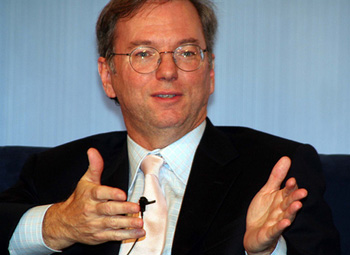
There are some reports coming out about the Web 2.0 conference in San Francisco. I am struck by this photo of Eric Schmidt, CEO of Google, by JD Lasica from Ourmedia. He looks the part for a solid business event. Last year Tim O'Reilley in a suit was not quite as convincing.

I am not sure how Google will be seen during the Online Information event in London. A couple of years back there was some resistance to Google winning an award. There is still some opposition from publishers to the idea of scanning books. But it is clear that Google is viable so there is a base of people working with them even if that is not an overlap with the entire Online Information world.

Tuesday, November 07, 2006

Recent posts in other blogs connect with learning.

In IPEX 2002 I have noted that the availability of Acrobat 8 is a defining moment for me in that I realise what I like about all the previous versions. The addition of Flash through Breeze or Connect is not really what I am expecting and I don't yet see it as engaging. Making the server support for collaboration in PDF avaiable at a price more people could consider would to my mind be more of a welcome change. The effect though is that I realise I am now ok with online documents as PDF replacing print. The PDF design on screen is familiar froma paper experience. Breeze and Flash are moving us into video and animation. I am slowly getting used to this and am not at all convinced that it helps collaboration.

Also on wifi Exeter I have come to think that wi-fi is not contributing to festivals in real space and time so mucgh as extending the normal web outside of space and time. Not sure how this works as learning but the effect of video on YouTube and Google appears to work as souvenir and promotion of future events. More on this later, maybe linked back here as learning.

Monday, October 30, 2006

I have now started another Google custom search engine on JDF. This is still a major concern. I may be going back in time but hard copy is still a lot of what is going on. The main group still stays as PDF-IS9000-quality-learning. JDF is not as widely known as PDF so could put this out of balance if added.

Google are linking to an article by Eric Enge on how to do this customising a search engine.seems somewhere between quality and learning so I will keep coming back to this.

The search engine approach is making more sense but I still don't understand the theory of it. The 'Network Management Learning' discussion has questioned 'communities of practice' as an explanantion of the web given the weakness of the links. Search engines are about as weak as links can get.

There is a lso a lot of theory about language and contested words. The ones that are interesting for me at the moment are

Antiperformativity

Co-op

Learning

Engagement

Communication

These will come up more in the swickis than in the Google customised search engines (GCSE may not take off as a term in the UK)

Google co-op? Surely it is a quoted corporate? It may not have done any evil as yet but there could be more pressure on it if the sales growth ever hits a bump. We just don't know. Meanwhile the ICA has a claim to the co-op word. Whether the ICA has taken web technology as far as it might is another question that can be returned to.

Chris Grey has written 'Against Learning(PDF)' in a way that prioritises education as in established structures and disciplines. A search engine about 'learning' is connected to online even without an e as in "e-learning" or some other new set of words. It may include informal learning or just adult experience. "Anti-performativity"

"Engagement" is a word Adobe use to describe a new platform including Flash as well as html, pdf and xml. My problem is that I don't usually find Flash engaging. Not just the annoying banner and popup ads. Flash paper is likley to be followed by a reader that moves PDF into Flash. Maybe some people will like this but there is no way to copy text out for your own comments or to combine with something else and construct new meaning.

Video is ok as such and I realise Quicktime files are usually larger but it is possible to edit them. Streamed Flash content has gone. Maybe this is good for content owners but it is not engaging.

I have yet to meet anyone from the London College of Communication who would not prefer to back to the College being known to be about Printing. Maybe the word 'communication' has yet to be explained and promoted. Maybe other words would help explore this. The 'Knowledge Based Economy' may have started with printing. Maybe earlier but print technology gave it a boost. I will try to check out the KBE again. It may just be mostly words but there may be some basis as well.

Thursday, October 26, 2006


I have started some search engines with the new Google approach to customisation. I still think Eurekster and Swickis will survive as they are more like a network. The design tolerates muddle and ambiguity, at least the way I use it. The Google approach seems to be looking for where to concentrate for maximum traffic. This is not always the best way to make new connections or allow for changes.

On the learn9 site there is a diagram 'hello spiders' where the swickis more or less fit together.

The Google ones are just about four things -PDF, ISO 9000, quality and learning. There is an overlap but you would have to do the same search in more than one of them. this assumes I manage to build some influence into them eventually. So far they seem to largely follow the main Google system.

'Learning' seems to me to be a good term, the fact this is an online search engine is enough of a clue without using e-learning, or ICT, or technology enhanced learning or networked management learning or information systems or whatever is claimed to exist at the moment. Last week at the LCC Futures Conference there was a fairly convincing case made that most e-learning projects have failed in their stated intentions as designed. However in the discussion on web design and Web 2.0 there was frequent use of the word 'learning', just to describe something that happens in normal life. Normal life includes the web so the technical term may be 'blended learning' though 'learning' has a meaning for most people.

There is one about ISO9000 as I realise this is still important. The learn9 swicki gets more searches on this than I expected. The 'quality' one will have a much wider scope, including critique of ISO9000 and alternatives.

There is another one about PDF, a scope that includes print and web. As an Adobe fan, i try to keep an open mind about Flash but I think PDF will be a focus for a while yet.

Links to the new search engines-
PDF
Learning
ISO9000
Quality

Wednesday, October 11, 2006

Trying out how to embed video. The link works ok in the previous post but I am inspired by an example on Buzzmachine from Jeff Jarvis.

So here is a copy of some YouTube code-

Email may not be junk. I recently got a newsletter from Epic that makes more sense than most of what I come across about e-learning. Steve Barden's article is headed "Latest Leadership Thinking – Let 'Me' Be Your Leader". It looks at how informal learning is taking advantage of technology.

"To a great extent I think the learning culture in many organisations has moved faster than the culture of training. Learners have taken to doing it for themselves through Google and a whole range of new online collaborative resources and tools. Informal learning has eaten into training territory on the back of this online expansion and significantly affected the learning culture."

It seems to me that YouTube could be included here. There is some mindbending rubbish but also some detailed instruction. Until recently, searching on "Bert Jansch" found almost nothing by Bert Jansch but several home videos of private performances. There is an extensive discussion including requests for detailed views of how a tune is played. See for example . The comments include some criticism that is then accepted, so don't take this as the best example for the little finger.

The discussion also covers the correct spelling of "Anji" or "Angie" quoting use over fourty years of history. "Angie" may be a different tune, only based on work by
Davey Graham. Since October 5th there has also been an extract from a BBC4 tv session. This may reflect the new acceptance of YouTube or it may not last very long. Suggest Bert Jansch fans check it soon.

If this is the "new thinking on leadership", we seem to be going back to some of the ideas around the "learning organisation". Energy from people directly involved in the process, that sort of thing. Maybe the Epic thinking is for practitioners and academics are finding "leadership" more interesting as a focus. YouTube could offer some stories for more than one approach.

Tuesday, October 10, 2006

I have added a poll at the Squidoo lens on W.E. Deming.

It asks if the Deming approach ever been tried in the USA?

It is known that Deming was listened to in Japan in the 1950s. Apparently he was listened to by Ford and others in the USA in the 1980s. Did they actually understand what he was saying?

Keep scrolling down, the poll is at the bottom of the page.
I am beginning to get stats on my Adwords program. Five actualk clickthoughs so far but lots of info on words that are used.

"search constructed knowledge" has had no interest at all so I have taken it out of the copy. Replaced by "learning with search". "Learning" has a following so this may work better.

Monday, October 02, 2006

Following Google University I have been thinking more about words and numbers and how to link in to advertising. Looking again at Eurekster it turns out they have started to include advertising so I have added this to each Swicki. I am about to get some actual stats on a global basis, well not global exactly but from the web as a whole. Previously trying to reach a UK audience has been confusing, all the stats show a 15% UK audience or close to this.

Information World Review is now covering 'Office 2.0' as well as 'Enterprise 2.0'. As the Wikipedia prefers 'enterprise social software' I have decided to add all the options to the learn9 wordcloud. They are each very small at the moment. For 'enterprise 2.0' there were 130,962 sites earlier today. The 'Enterprise Social Software' in Wikipedia showed up ahead of the ZD Net blog. 'Office 2.0' finds 215,755 but I think some are just about Office in general. 'Enterprise Social Software' finds only 45,012 but they ae mostly interesting, extended blog writing for example. 'Information 2.0' finds 461,301 but I can't see any pattern in this. It is a term for the Online Information show. i may add it if something else happens. I may take them off again, but it seems a good way to track some of the discussion through the conference phase.

Saturday, September 30, 2006


This photo from Google University at AdTech. I plan to compare this with the Online Information event later this year. In the UK normally you need the Privy Council to agree to the use of the name "University". Somehow the US approach is gaining strength that companies can set up a university as well.

More on the content later. A lot of it was round the idea of a 'quality score', mostly based on how relevant your advert would be to a particular search query. I am thinking about how this fits with other quality theory.

Meanwhile Google Video seems to have given up the struggle with YouTube and opted for the high ground and more academic content. UC Berkeley have deposited a mass of course records. I liked one about search quality but it took them a while to get the slides working. The video just rolls on, this approach is not very mysterious.

The Online Information event is around the theme of "Information 2.0". Not sure what this implies but I am trying to mix it around "Web 2.0" just to check out what the official information scene has to offer. Open Access Journals for example do not yet carry the same weight as the expensive ones but some form of knowledge exists just through search and the web in general.

I have put a comment on the official blog, following on from David Weinberger last year. The IWR blog seems to be questioning the "Web 2.0" term as suffering a loss of meaning over time. The conference in San Francisco will surely come up with something though.

Wednesday, September 27, 2006

Off to Adtech tomorrow, including the Google University. Almost entirely about advertising and stats analysis, I think. The use of 'university' as a word is a US approach, when applied to companies. Personally I think a Google University should exist all year round not just on special occasions. There is an online version so this is a case of 'blended learning'.

Meanwhile Cambridge University has come up with a new approach to A Levels. See 'Fast Forward to the Past' in the Guardian. There is a very short list of suitable subjects for a new 'pre-U' qualification for the really bright people for the top unis. 'Media Studies' is not on the list, or design technology or IT. Economics ok but not sociology. Too close to media studies probably.

Tuesday, September 12, 2006

Back in Exeter. seem to have been in Lancaster a while.

Written for OhmyNews about buildings and open space in Morecambe.

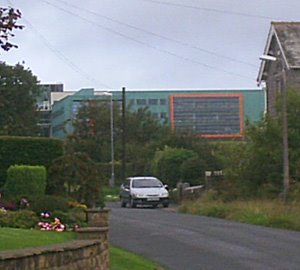
I didn't mention the buildings on the campus as they were not part of the schedule. 76 Church Street is currently in use for a mobile computer operation. Lots of personal computers on a network. Seems to work ok even in a Jacobean / Georgian context. So why is trhe university showing off InfoLab? For 40 years or so most of the buildings were hidden from the motorway. In the discussion on the KBE there was not much discussion on technology as such. What sort of equipment is inside the building? an IBM mainframe? Some sort of cooling device for a hot chip? Maybe they could have used an old building instead. Is the shape just rhetoric in another form?


viewed from Galgate


official photo

Friday, September 01, 2006

Yesterday wrong about the statement there are few people here from SE England. Allan Willimas is here from London Met. Paper on mobility but I missed it.

Thursday, August 31, 2006

Day one of the Knowledge Based Economy conference. I am in the library where the web works ok but there is no coffee. Otherwise fine.

Conference has started well. the idea of knowledge is not limited to academic sources. Michael Hulme emphasised personal knowledge and collaborative knowledge creation through blogs and wikis. "The onus of critical judgement is thrown back to the individual."

John Urry commented that the role of the individual is balanced by a dependence on computers and electronic systems with 'a dark and dystopic side of systemic dependencies' liable to catastrophic failure. Not sure if systems will be seen with any encouraging potential but this is only day one.

Some discussion on whether the KBE is centred on London and the south east in the UK. One thing I notice is that the people attending are not from Oxford, Cambridge or London academic sites other than DEMOS. Not sure why this may be.

From the first workshop I discover that 'excellence' and quality are among the top issues in editorial coverage of higher education in the USA. Based on looking at 252 articles in the New York Times, LA Times and Washington Post. So quality could be a topic of interest for academics. The discussion suggested that most of the articles responding to journalists came from individual academics rather than any organised presentation by universities as a group.

Tuesday, August 29, 2006

I have started a topic on the Prolearn discussion space

http://www.prolearn-online.com

forums and polls , then "Engaging SMEs in e-learning"

My paper is a bit off topic for e-learning but a lot could follow. I have put some questions about 'network management learning' at the end. I still don't understand most of what is written but it could be worked through later.

Monday, August 28, 2006

I have printed out copies of the paper for the IAS conference on the Knowledge Based Economy, so that is the final version this week.

PDF version now on the Learn9 site.
Also an open document. Open Office required but I am gradually getting used to it and I think most people should have access to a copy.

The slides PDF just as previously. About 2 meg.

Meanwhile I am trying to update an article on quality for OhmyNews. Previously i did one based on Quality Circles and mentioning ISO 9000 towards the end. I am trying to do another one leading on the latest ISO survey. This continues to show growth in China and slight decline in the UK. It has been suggested I should explain more about the background so this needs working on. Maybe I will get some ideas during the conference.

One problem I can't avoid is that I do not know anything about how ISO 9000 is used in China or an Asian take on quality. The journalism takes the form of asking a question. Maybe later others will send in reports to OhmyNews and the editors will shape something together.

Current version-

Continued growth in China use of ISO 9000
Mixed sector pattern in USA and UK

The ISO survey for 2005 shows continued growth in the use of ISO 9000, a standard for quality assurance and in the environmental standard ISO 14000. The two standards are connected by a common approach to auditing, systems thinking and learning through corrective action and system review. Growth continues strongly in China, where there is now the largest number of ISO 9000 certificates. Growth in the UK has stopped but there is interest in the specialised standard for medical equipment.

China now has 143,823 certificates, up by 10,000 from 2004. The ISO comments that "the strong performance of China, which is again in the top 10 countries for growth in both ISO 9001:2000 and ISO 14001 certification, and of India, which is again in the top 10 for ISO 9001:2000 growth and enters the top 10 for ISO 14001 growth, is no doubt partly linked to their increasing participation in global supply chains, in export trade and in business process outsourcing."

The standard may be seen as essential for getting onto the list of suppliers for companies that also use ISO 9000. There has not been much research on how the standards are used but given the current scale there are probably sites where the standard is being used creatively.

In the UK the number of certificates is now below 50,000 rather than above as in 2004. There had been a previous dip while companies adjusted to the revised version of the standard in 2000. The standard originally started as a UK standard (BS 5750) so some observers have suggested that the UK decline in use shows there are problems in maintaining the paperwork and that long term benefits may not occur. The 2000 revision calls for involvement by senior management in system review. It is possible that there has been some reluctance around this.

The ISO comments on the rising importance of services in the global economy. "nearly 33 % of ISO 9001:2000 certificates and 31 % of ISO 14001 certificates in 2005 went to organizations in the service sectors. The latter statistic also illustrates that good environmental management is not just for smoke stack industry and that service providers are accepting their social responsibilities in this area."

Japan is way ahead of China on the environmental standard - 23,466 compared to 12,683. The USA has just over 5,000. Japan has other approaches to quality but the support for ISO 14000 suggests that it is possible to use the methods as part of a management approach.

Figures are also published for two specialised standards based on ISO 9000. ISO 16949 covers automative products in the car industry. This replaces previous industry and company standards. In this sector the USA leads with 3,693 compared to 2,151 for China and 2,115 for Germany. The USA also leads on ISO 13485 for medical equipment with 1310 certificates, followed by the UK with 973 and Germany with 824. There has been a view that the USA has had no need to adopt ISO 9000 as quality policies already exist. This may change with the example of automative and medical. At least there will be some sectors with relevant experience.

I am unable to explain the mixed pattern across countries and sectors. There is very little information available on how the standards are used. Other reports for OhmyNews might help to give some background on particular countries or regions. The recent conference on citizen journalism considered 'best practices' so some quality theory could be relevant without getting too lost in ISO language.

There is some evidence on the web that ISO 9000 systems can work alongside quality circles and moves for improvement. Joseph Nebus has reported on a trip to Thailand where he had his first trip in an ISO 9000 certified taxi. He found much publicity for ISO 9000 also in Singapore as well as support for quality circles with 12% of the workforce participating.

By contrast, quality circles have almost disappeared in the UK. David Hutchins recently updated an article on his website originally from 1982, with this explanation-

"In the year 1998 there were reported to be more than 20 million Circles in China and in every country in the Far East. Both Toyota and Honda announced in 2004 that they are going for 100% involvement in Quality Circles in all of their plants worldwide.

Toyota and Honda are both making huge profits in their manufacturing plants in the USA, China is about to enter that market. At the same time, General Motors are reported to have lost $1.5Bn in the first six months of 2004, MG Rover was liquidated and the plant is now owned by the Chinese.
Ford also lost money and Chrysler are currently in deep trouble. Of course it is not all down to Quality Circles, it would be stupid to suggest that it was but they are part of the reason and that is good enough! Why do Toyota and Honda clearly regard the concept to be so important whilst the West completely ignores it? Who is right? ."

My previous report "Quality Control Goes Round in Circles" covered some background to this. One possibility is that the approach to quality circles has a consequence for the suitability of ISO 9000.

Saturday, August 26, 2006

I have started up a home on US Cyworld. It takes a while to get used to this. Mostly for swapping music files etc. i guess but I am also interested in how quality ideas fit in. I found out about Cyworld through OhmyNews. The US launch is a new phase. I have started a 'quality club'. Unfortunately I can't load a text or graphic. Text ok but graphic falls over and then you can't save anything. I think the launch is official, not a beta site but still an issue there I think. Maybe I should be scrolling down to some other button.

I have written for OhmyNews a report on the latest ISO survey on 9000 and 14000. The growth in Asia contrasts with UK stasis. Hard to explain and I can't claim to know what is happening. OhmyNews and Cyworld may contribute a space for a discussion. They are based in Korea but gradually involving wider communities.

Friday, July 14, 2006

Meanwhile the OhmyNews Forum has been totally solid as far as I can tell. I have been back to sleep so am more or less on UK time now. The webcast worked ok for sound, then mostly stills a bit jerky. The slides were missing sometimes. Still, a lot will turn up later.

I think the move to start something in Japan will probably work ok. There may be more podcasts and video as things turn out.

The Korean base seems really strong in social terms as well as technology. My impression is they did less visits than last year to technology sites. But there was mention of wireless speeds as a government concern.

The 'knowledge-based economy' is a reality in Incheon.
Next week there is a space for my paper during the workshop on organisations as part of the Lancaster IAS project on the Knowledge Based Economy. It seems awfully soon.

the paper is intended for the conference at the end od August. I have redone the website more or less as a sequence so I will work some more on that.

I get the impression there is more readiness to look at quality and organisation, even as part of a critique of some rhetoric. There will be a look at cultural industries involving the local RDA as part of the conference so there must be some reality to it.

I notice Peter Checkland has a new book coming out - Learning for Action - that seems to be an introduction to other works, including information systems. I think I will add this in. I have always thougt that SSM was about learning but somehow the Department of Management Learning has rarely made much of a connection. And contrarywise. I can't remember anyone from Management Science being at the conferences organised by Management Learning.

The Institute for Advanced Studies is not based in a particular discipline so this could be a good chance to look at this again.

Wednesday, July 12, 2006

The OhmyNews Forum is about to start. They are eight hours ahead of UK so tomorrow is a bit sooner.

There is a story already with a welcome and comments from Oh Yeon-ho, founder and CEO of OhmyNews

------------------------
"Two of the most prominent buzzwords in recent years have been Web 2.0 and UCC (user-created content). Underlying both concepts is the belief that collective participation will lead to an optimum solution or conclusion. In other words, decisions will best be made when there is truly mass participation through the Internet.

While giant corporations rush to find a way of commercializing these concepts, citizen journalism, I believe, represents the most developed model for Web 2.0 and UCC. It depends not only on the participation of the masses but on the participation of those who think critically and creatively.

Writing a news story requires a good deal of time and consideration. It is much more difficult, for example, than leaving a comment or posting a blog entry. Though we are an open platform accessible to everyone, not everyone can write a news story. Only those citizen reporters who are passionately committed to social change and reporting make our project possible. The main reason that citizen journalism has not grown and spread more rapidly is the difficult task of finding and organizing these passionate citizen reporters in waiting."
----------------------

I think these issues are very relevant for my attempts to link ideas about quality and learning. Oh Yeon-ho speaks of the difficulties of "organizing" so there is an organisation aspect to what OhmyNews is developing. I think there is a quality aspect when he says that underlying both the concepts of Web 2.0 and User Created Content "is the belief that collective participation will lead to an optimum solution or conclusion."

To say that citizen journalism is "the most advanced model" for both Web 2.0 and UCC is a significant claim and is making sense so far.

The webcast could be about 2 or 3 pm UK time. Not sure if there is a repeat.

Thursday, June 29, 2006

I have added a page about stats for the paper draft. The recent Deming SIG meeting on SPC reminded me that this an aspect of websites I often forget. The problem with the UK Acrobat Services site is that most of the audience is not from the UK. Nothing seems to change this. I started the US focus site with a ".com" and the first page of the co.uk suggests people go there if they are not in the UK. Not much difference, the process is not in control.

But the Swickis seem to be working ok in terms of getting searches more or less as expected.

'soft systems' is doing well on the learn9 swicki. I may try to look at this again. There may not be enough time for this at the conference but it could come up as part of looking at Deming on systems thinking.
I have started to look at Prolearn again. They are an EU project on professional e-learning. My impression is they have no problem in admitting 'quality' as an element in their thinking. They want to end up with methods that can be shared with people working in companies. That is not to stop them coming up with new research ideas of course. Just because they accept quality they are not restricted to a 'positive' methodology. Recent conference on social software. Links to blog. Links to blog conference. Maybe it is just another example of rhetoric to disguise a neo-liberal project. But I think there will be more to find on Prolearn that is interesting for the KBE discussion.
Later today there should be a guide to other blogs that I work on or at least a diagram as part of my learn9 website. This is about learning so one current idea is to make the blogs at least appear more coherent. I have tended to just start another one and then not continue.

Thursday, June 22, 2006

Just had another look at M@n@gement. The site design has been updated. Much better, in my opinion. More space around things. Previously it looked to me that the list of articles was the only focus. Now it is easier to navigate the site. Also there is a search option, using Google. The only problem I find is the page with a form for submitting an article. At least this has a date - autumn 2006 - when nthe form will be available. This is consistent with a corrective action procedure.

Also the description of what they will accept mentions video, sound anything that fits. So far I can't find examples where this is used.
My paper proposal has been accepted for the Lancaster conference. Update needed for the website, maybe tomorrow.

The Swickis seem to be working. Somebody has pushed a relevant result for CMS up the list in the Anti-Performativity one.

Should be this one. Not sure if it will still be top of the list. This is about how to engage through CMS but I still don't know how people have followed this up.

Tuesday, June 20, 2006

It turns out my comments on the blog were not that relevant as the blog is only meant for an audience that already understands some Buddhist ideas.

The Coaching Buddhists website as more.

Phone conversation with Viramitra convinces me that things are more complex than I like to assume. Terms like 'Asian values' are not obvious in meaning as Buddhism can be western. I still think there is something about the approach to quality in Asia that is different to what I usually come across in the UK.
One theme that will probably come up in Lancaster is that on the web there are many 'weak links', so many that ideas around a 'community of practice' stop making much sense.

Recently a friend in Exeter has started to blog so I can experiment a bit in exchanging some words online and then check out what he makes of it in real time and space. The blog is here.

My first comment is that this is not yet much of a blog as such. It is a copy of an article. Also as it was originally written for a Buddhist audience it needs more explanation for the open world of blogging. What are the "Brahma Viharas" ? I have found a website through Google but need some confirmation this is along the same lines as the blog.

Western Buddhism is definitely a useful reference point, relevant currently for discussing OhmyNews and ideas about quality. Fortunately if I try to write about 'Asian values' and management theory the editors at OhmyNews can rewrite it to appear resonable. Making sense of this in a way that can work in the UK is going to be more complicated. There are a lot of Christians in Korea by the way. Generalising is problematic but that probably won't stop me.
OhmyNews have published my report on the Knowledge Based Economy conference coming up in Lancaster.

They have changed the headlines and rearranged the text so it appears a lot more sensible. I managed to slip in some of the argument I hope to include in a paper proposed for the conference. You do get a 'voice' with citizen journalism, that is a major point.

I am trying to think of the next few months as one event, maybe up to the Online Information show. Even if the 'paper' is not accepted, I will get some feedback and the words can take some other form.

Sunday, June 18, 2006

Manchester as a Knowledge Resource

Conference to close with a return to reality

(this is text as submitted for OhmyNews)


An academic conference on the 'knowledge economy' will close with a keynote from Dr Cathy Garner, currently Managing Director of Manchester Knowledge Capital. It can be assumed that this will relate at least some of the discussion during the conference to a description of actual Manchester as it exists.

Themes include "Discourses and Narratives of the Knowledge-Based Economy" so there could be analysis of some claims as if they were rhetoric, intended to disguise something else. The conference description states that "The Knowledge-Based Economy (KBE) conjures a world of smart people, in smart jobs, doing smart things, in smart ways, for smart money, increasingly open to all rather than a few. It has become the dominant economic strategy for many countries, regions, and cities and is endorsed by many economic, political, and social forces. It has also been criticized for creating a digital divide, new forms of social exclusion, and restricting access to the intellectual commons."

There is a "critique" strand in academic thinking that tends to see any set of words as part of a neo-liberal project to assist globalising capitalism. KBE could be interpreted as just the latest version of this.

Some of these topics relate to the OhmyNews conference on best practices for citizen journalism, both about technology changes and associated developments in culture and social organisation. The 'ubiquitous dream hall' is clearly a showcase for the Korean IT industry but the main topic will be the practice of citizen journalism and wider access to 'the intellectual commons'. My own impression is that citizen reporters are just a part of citizen journalism and that the editors, software and organisation are significant elements. Studies of formal organisation are not always seen as interesting, but I think they remain relevant.

This will be the first major conference organised by the Institute for Advanced Studies, a new initiative for interdisciplinary and postdisciplinary research in Management, Social Sciences and the Arts & Humanities. The Knowledge Based Economy is the focus for the inaugural annual programme, a series of workshops leading up to the conference.

Previous conferences at Lancaster have included two about 'Management Theory at Work'. The idea that 'citizens' or 'practitioners' can contribute to such conferences is officially welcomed. See the recent article by Claire George. However this cannot always be easily reconciled with other views expressed. One closing keynote by Chris Grey argued that Business Schools could not and should not claim to offer any managerial knowledge, but should continue the university role of critique in society. Similar ideas are expressed in a PDF working paper 'Against Learning', available for free download from the Judge Business School in Cambridge.

One of the research clusters at the Lancaster Institute for Advanced Studies is around 'Performativity'. As described on the website,- "Organizations, institutions, nation states even global regions are often portrayed in terms of their performance. Performance itself can be viewed as institutionalised, ritualised, commodified even deified if the discourse pervading managing the public sector is anything to go by."

It is also the case that "Anti-Performativity" can be seen as having so strong a base in universities that it is a problem for practitioners to grasp where theory can be related to any form of activity. My own interest is mainly in quality systems. Since the book 'Making Quality Critical' by Wilkinson and Wilmott was published in 1995 it seems to have been difficult in the UK to relate quality assurance ideas with the study of 'learning organisations'.

The discussion around citizen journalism includes an aspect of 'critique' based on American pragmatism. At last year's OhmyNews Forum, Jeremy Iggers spoke about how he started an experiment in civic journalism in the U.S.

"At the time, I was finishing up a doctorate in philosophy at the University of Minnesota, and writing a dissertation about the ethics of journalism. One of the philosophers who influenced me most was the American pragmatist, John Dewey, who wrote about the importance of having a knowledgeable engaged public that played an active role in democratic life. My thought was that it would be a good idea to see what the newspaper could do to foster public participation, and to encourage better public understanding of important public issues."

There is a connection between Dewey's ideas on education and Deming's ideas on knowledge as part of his approach to quality. This may come up in the discussion about best practices for citizen journalism.

Whatever the reservations about 'performativity', there will also be pragmatic conclusions from the conference on the KBE, at least relating to Manchester.

On 7th January 2005 UK Chancellor of the Exchequer Gordon Brown opened the new North Campus Incubator Unit, part of the University of Manchester.

"What a pleasure it is to be in Manchester to see the huge changes taking place in this great city that led the Industrial Revolution and is now leading the knowledge revolution of the 21st Century," he said.

The Chancellor added that the university would be a future world leader and the city and region would become one of the most prosperous in Europe.

This could be seen as just more "spin" but there is some basis in reality.

Monday, June 05, 2006

The good news is that comments are now working ok on the Auricle blog. Not sure why this never worked for me before. I started a Talk topic at the Guardian instead. I will try to keep the Guardian one going enough not to be deleted. It should be a useful place for comments around learn9.net . For the next few months I will be working around a paper for the conference on the 'knowledge economy' organised by the Institute for Advanced Studies at Lancaster. I don't think the paper will be accepted but it is a useful chance to sort out some ideas.

Meanwhile I am getting some response on the new swickis for learn9 and 'anti-performativity'. A swicki is a form of managed search engine that builds on feedback. I get stats on existing terms and new ones. At the moment 'anti-performativity' gets most interest. 'learn9' is not known, I guess. I think the 'critique' view is definitely part of the discussion, evn though i see it mostly as a block to linking ideas on learning and quality. Maybe during the conference someone will explain how a form of action would follow from 'anti-performativity' in the context of the knowledge economy.

I have also done a guide to several swickis as a hello for spiders.

Tuesday, May 30, 2006

David Weinberger is still working on 'Everything is Miscellaneous', a book version of his talks from last year.

Apparently there will be about a year between delivering the manuscript in July and the actual publication. So "the book" is still in there. Cobbling together bits of blog will also serve some purpose, especially if something new crops up while the editors are still working on the text as delivered.

Sunday, April 02, 2006

Still concentrating on IPEX, but this has carried over into learning.

"Web 2.0" keeps turning up as an explanation of what is happening. Print has to operate in this context.

However "Web 2.0" is still so loosely defined that it could involve anything. There could be a quality aspect, a learning aspect, and an aspect for communications or whatever print is part of.

I think this IPEX could clarify a few things so this blog could be sorted out soon as well.

"e-learning" has even been mentioned in the Bookseller part of the Saturday Review. So the Guardian is moving the bookish discussion online, even if slowly.

Tuesday, March 21, 2006

I am concentrating on IPEX at the moment. It could be an occasion when the print industry is definitely seen as part of a communications industry based on the web. My blog is still called IPEX 2002 but there is not much point in changing this.

I may seem to be going backwards. The new Acrobatusers website has more or less ignored print and pre-press in favour of 'knowledge work', more or less Acrobat for the desktop. I still think hard copy is part of the discussion. For one thing going back to publishing assumptions is useful even to think about online.

Also I am beginning to see PDF as only one option. It is possible to move in and out anyway. The PDF project has been to move documents from paper to web. this now can take many forms.

I have continued to move studies around quality and learning into journalism. There is a story at OhmyNews around 'comment is free', the new website from the Guardian. I think "citizen journalism" is going somewhere, and there is a related discussion about knowledge authority that will reach academic journals at some point.

This is an example of how the print context is relevant for a web discussion. I have tried to follow a story in Acrobat Services UK site about the ABC circulation certificates that could include 'digital editions'. So far no UK newspapers have 'opted in'. My current guess is that sites like 'comment is free' will allow print journalists to get more used to the web and some writing about news oprganisations in print and online will follow. Circulation figures and a business model will follow that.

Today the Guardian reports that the BBC is about to take on "web 2.0". This is confusing. Recently someone at Life Bytes said that "web 2.0" could mean anything. this turns out to be true. The BBC seems to think that "web 2.0" means working with Microsoft and Sony. Surely they are not into open source at all? Sony keep coming up with strange formats for storage.

So I think "web 2.0" could be a suitable topic for the conference on the 'Knowledge Economy' coming up in Lancaster. One debate seems to be about realism and linguistics. As in there really is a 'knowledge economy' or the words are used for some other reason ( a neo-liberal plot to restrict academic freedom for example ). When OhmyNews refers to Web 2.0 as part of their press release on working with Softbank on a site for Japan and expanding into TV, I regard this as realistic. They mean to do more or less what they announce. But "web 2.0" could also be rhetoric, and there seems to be some variety in how this used.

Friday, February 24, 2006

I have put about learning through games in the animX blog. Games are now well thought of. The Careers Day established that almost all work in animation studios is on short term contracts. No shame apparent from the panel in suggesting that about the only way in is to offer to work for free. By contrast there are still employment contracts in the games industry, even though most companies go bust.

Anyway, back to learning theory. The games as learning link came from Donald Clark's blog based on his talk about 'informal learning'. I guess I can cut and paste about three paragraphs-

"
I don't want to pit formal learning against informal learning. It's simply a matter of balance. We have far too much time, money and effort spent on the formal side, while the informal side receives little or no attention. It's not that there's a lack of ideas and opportunitiess at relatively low cost.

Level 1 - Word of mouth
1. Open office structure
2. Proximity and line of sight seating
3. Non-departmental seating
4. Staff area with relevant magazines
5. Budget for staff get-togethers
6. Brown bag lunches
7. Book club/Budget for books on Amazon

Level 2 - Word of mouse
1. Skills database or profiles
2. Intranet with workflow structure and linked learning
3. Online quality system linked to workflow
4. EPSS software
5. Email
6. Instant messenger
7. Discussion boards
8. Blogs
9. Wikis
10. Podcasting
11. Syndication
12. MMORPGs

MMORPG is short for Massively Multiplayer Online Role-playing Game, see Wikipedia

This is another chance to mention the very welcome return of actual space connected to the web. Life Bytes has a site opposite the Odeon on Sidwell Street, Exeter. 01392 214214. Any budget for upgading the kit will probably depend on the games aspect. There will also be a training policy.

The 'word of mouse' list includes an online quality system linked to workflow. This is what the learn9 site is about. It has become a bit of a mess, but will be sorted soon.

Thursday, February 02, 2006

I'm still thinking about the workshop on eduacation and the "knowledge economy". More later.

It is in quote marks as this is how the academics seem to think about it. I am trying to find out more about a "linguistic turn" and a "realistic turn". Can't make it out at the moment.
----------------
Mr Gillmor said that the rise of participation from ordinary people means that traditional media must stop lecturing and begin a real dialogue with its readership.

"There is the absolute democratisation of the media with the [ability of] anyone who has access to increasingly professional and cheap tools of production to publish to a global audience," he said.

"It has a big meaning for traditional journalists ... who have to shift from lecture mode into something more like a conversation. The 'former audience' know more than we do and once we embrace that, we can get in to some powerful journalism."
------------------

Extract from Guardian report on discussion at Al Jazeera forum

The same sort of change is happening with teaching and learning, so this will relate to actual lecturers as well.
The Guardian is soon to feature an online opinion discussion called 'comment is free'. Not sure when it will launch.

They recently hosted a discussion about 'citizen journalism'. I'm not sure they understand how far it could go. They mention the NUJ guidelines on "witness reporting" as if occasional photos are all this is about.

I have been posting to Guardain Talk about OhmyNews and also stories on AL-Jazeera. I think soon there will be a bit more clarity on how different forms of media can work together.

Meanwhile I will probably do more blogging and less on Talk.

Wednesday, January 18, 2006

I hope to contribute something to the meeting about 'education in the knowledge economy' in Lancaster later this week.

http://www.lancaster.ac.uk/ias/annualprogramme/kbe/education.htm

There is another event later on organisations and a conference in August. I might try to get a paper together, the deadline is in May.

I am interested in educational organisations. It seems a good focus for ideas about management, leadership etc.

The 'learning organisation' is one suggested topic for the conference. Could be linked to quality assurance.

One theme seems to be a critique of the idea of the knowledge economy as if it were rhetoric, some form of oppression through language etc etc. In some academic contexts it could be challenging to suggest that many descriptions of the knowledge economy are simply stating facts.

Thursday, December 15, 2005

I have put a link on the Prolearn Forum site to let them know about the article on OhmyNews.

Not sure if they will follow it up but the Approach to knowledge push and pull is useful. There is a part of the Prolearn project to add metadata to learning objects so they can be sequenced. Maybe this won't matter if people work out a sequence for themselves.

I think learning theory is just one aspect of something that happens on the web anyway. Everything is miscellaneous, as in most assumed subjects.

Wednesday, December 14, 2005

I have updated the webpage for Animex, a digital fringe for Animated Exeter

http://www.acrobat-services.co.uk/animation/

There is a page on 'learning' to cover training and education. There is a careers day and also workshops on Photoshop and Flash. This year the Careers Day will be at the Phoenix where there is also now some web access. So a lot could happen around this. I got some CDs off both Adobe and Macromedia in previous years so people goy trial versions. Still not sure what will happen with Adobe / Macromedia but this can be discussed during the festival.

I think I may be going backwards towards hard copy. While Flash in PDF is sorted out we may as well knock page layout on the head. the software is pretty much there surely.

This 'learning' blog may end up much like the other blog on IPEX 2002 , a print show. If 'everything is miscellaneous' as David Weinberger has stated, then these blogs could be better linked.
OhmyNews have now published the HighWire story. they also put links to some of my previous writing, going back to the original one on the Guardian. I think the Highwire story marks a new stage. The web based knowledge has some plausibility, or at least a theory. I will continue writing up reports as journalism. Maybe later come back to academic forms of writing but I don't think the UK scene on 'management learning' welcomes stuff that is too practical.

Thursday, December 08, 2005

Quality World has an article about ISO 9000 and the recent ISO survey.

The UK is dropping way behind, as I see it. This article has very little prominence compared to previous years when the whole December issue could be about ISO 9000.

I don't think it is sensibe to hide the numbers away. My guess is that in Asia some companies are able to run ISO 9000 and do stuff with quality. the numbers show that momentum has moved there.

The article mentions anxiety and apathy. Maybe this is just in the UK.

More later. The article is not yet on the IQA website.
I have posted a story for OhmyNews on HighWire Press offering free journal articles. the occasion was the Online Information show. David Weinberger's keynote on 'Everything is Miscellaneous' is a defining moment, the way I see it.

He challenges accepted ideas about how knowledge is organised, not just in libraries but in subject areas for study. My previous efforts to work with modes 1 and 2 just slot into a much larger picture. He has been putting out similar ideas for a while though, but this is a major venue even if it is a trade show.

Web search reveals similar presentations to the Library of Congress and the Oxford Internet Institute. Suggest search on "everything is miscellaneous".

This kind of approach must be relevant for e-learning. It is coming out of the environment people are using anyway.

My concern is to open up a space where ideas about quality can be included as part of e-learning. I don't think all academics realise the implications for universities as organisations. Maybe they do and just don't like it.

The Online Information event is taking the opposite direction to their keynote speaker. Most of the stands are for content, but there are is maybe a fifth of the space at the back divided up into various labels for technology. Content management, knowledge management, documents and records, search engines and also e-publishing. My claim is that knowledge management implies e-learning. Tim O'Reilley suggests that publishing becomes collaboration in web 2. Blogs and wikis were hot topics this year so maybe Web 2 will be a label sometime soon. Let's assume that Tim O'Reilley will be the keynote speaker for 2006. This is a heuristic device to speed things up.

Friday, December 02, 2005

This could be a relevant link from a previous conference.

Not much has turned up from Online Information by way of comment on the keynote. Maybe there needs to be some time for reflection.

On the official blog David Tebbutt reported that "Nervous laughter echoed around the room. But, in between the laughter, you could almost hear some deep thinking taking place. Engage with the New World or seek early retirement."

By the official blog I mean the Online Information blog. This itself records that the only person with an official blogger badge was Nancy Garman from Information Today.

Wednesday, November 30, 2005

Trying to find out more about blogging

Apparently I should post this code to turn up on Technorate


This from the Info Today blog


They have a report on David Weinberger's keynote, around Tuesday

Tuesday, November 29, 2005

This is a straight copy and paste from the excellent blog hosted by Information Today

According to Weinberger, who is a philosopher as well as digerati, weare building a hugely messy web of linked metadata, and knowledge isnow constituted by what's interesting to us, not to an unknown expertor rigid Aristotelian hierarchy of information. Now, user-generatedmetadata completely flips the role of an expert. It flips the basicsfrom limits and experts and filters to a way of ordering that isinclusive and can handle an formerly overwhelming abundance ofinformation. No longer is there a limit on how much information we canhave, and no need to filter it on the way into a system, but only onthe way out, and then by a random group of users whose tracking andtagging converge to form knowledge.Weinberger said knowledge now is defined by:What: What's interesting (to us)How: By talkingWho: EveryoneWhere: In global conversationsWhy: Because we care"Knowledge IS the conversation," Weinberger said, turning upside downthe established frame of reference of most of the knowledge workers inthe audience.

Nancy GarmanInformation Today, Inc.ngarman@infotoday.comTechnorati Tag:

http://www.infotodayblog.com/

see my draft article

http://www.acrobat-services.co.uk/drafts/highwire.html

so there is some new copy to work into this later

Meanwhile there are no easy quotes to use from visiting stands

Highwire Press definitely back the ide of proper academic structures and peer review for journal articles.

Google staff in person have nothing to add to what you can find on or through Google.

However, the idea of knowledge push and knowledge pull makes some kind of sense.
Earl's Court still has some web access. Side street opposite the station at the moment.

Blog found at Info Today

http://www.infotodayblog.com/

Rely on this if nothing turns up here.

The official blog is at

http://blog.online-information.co.uk/