Saturday, April 28, 2012
London College of Communications
As drupa starts up I realise there may be a good case for the change of name. Communication is what the show is about. It is still the case that London College of Printing is well known. The London School of Economics has managed to persuade people that it covers other subjects as well. So there is still some debate but the LCC name is there at the moment.
I am also thinking about the Management Theory at Work conference or online phase ( search on #mtw3 ) This may include a case study such as the Open University where surveys on student opinion are fairly positive and the resources relate well to technology trends.
The LCC has had substantial cuts in funding. Creative skills for new media actually need a lot of equipment but as far as I can see there is no comparison with science budgets. There appears to be some issues, as indicated by blogs.
There must be some presentations available on what the LCC is doing from a management perspective. But I find the blogs and gossip more readily. Maybe this will continue in background mode.
Sunday, April 01, 2012
Peter Senge is still relevant for the Management Theory at Work conference I think. There are UK academics with a critique of his views, sometimes seen as too "vague". But this talk available on YouTube is interesting. It relates to sustainability and shows how this can be seen as specific to one company or to group interests.
.
.
Sunday, March 11, 2012
The Management Theory at Work 3 conference idea is beginning to work better. John Burgoyne has material for a current talk that I think can be traced back to his keynote at the first event. I have edited two YouTube clips from recent talks to the Suffolk University Campus and the Continuing Learning Group at Lancaster.
I have also set up a new Facebook group- #mtw3 - so that Scenechat can connect there. I think eventually Scenechat will work with LinkedIn but at the moment it is mostly for music and Facebook. YouTube as a home for academic conferences is so far a minority interest.
But now Gmail shows off everything you do the days of various identities on different channels may be coming to an end.
I have also set up a new Facebook group- #mtw3 - so that Scenechat can connect there. I think eventually Scenechat will work with LinkedIn but at the moment it is mostly for music and Facebook. YouTube as a home for academic conferences is so far a minority interest.
But now Gmail shows off everything you do the days of various identities on different channels may be coming to an end.
Monday, February 27, 2012
This is a recent clip on adverts and video from Adobe
Comments invited through SceneChat. There must be a way to avoid the ads from some events. Depends on the model. The demo of an edit from an iPad is convincing though. Together with the phones announced in Barcelona with improved video cameras this means that YouTube etc can get reasonable reporting on the same day things happen.
( I am still using a Kodak Zi8 and going home to a desktop with Premiere Elements so my own news can be a few days old)
Comments invited through SceneChat. There must be a way to avoid the ads from some events. Depends on the model. The demo of an edit from an iPad is convincing though. Together with the phones announced in Barcelona with improved video cameras this means that YouTube etc can get reasonable reporting on the same day things happen.
( I am still using a Kodak Zi8 and going home to a desktop with Premiere Elements so my own news can be a few days old)
Sunday, February 26, 2012
I am trying out SceneChat, a new approach to commenting in video. I think at the moment comments will go to Facebook but other sites may be added later. In Beta at the moment eventually there will be adverts linked to the discussion. Not sure if you can avoid them.
This video was found through discussion on Sustainability at the Networked Learning site
Please try adding a comment in the box or through comments on the blog post.
This video was found through discussion on Sustainability at the Networked Learning site
Please try adding a comment in the box or through comments on the blog post.
Monday, December 12, 2011
The Wild Show on Phonic FM has occasional space for some conversation. It is mostly a music show. Actually the music is the main point. But I can slip things in, having worked my way up from a guest on the New Exeter Radio Show, a fairly dangerous space but that is another story.
So there may be a new spot , the eleventh hour, that covers aspects of technology. Is it the eleventh hour for live radio? that sort of thing.
I missed the last couple of weeks but have sent in email etc. and met offline last Wednesday. Here is a YouTube clip based on photos and the sound from last week.
The clip explaining the eleventh hour as "the time when Exeter connects the cloud and coffee" is from me via Chris Norton iPhone to Soundcloud from Cafe 55 on Northernhay Street. Edited into a jingle by JD somewhere in Devon. Photos from Exeter cathedral yard and St Pauls both actual and in Twinity.
Universities and conferences could benefit from virtual worlds linked to actual space. It extends the access possible without reducing the value of actual face to face. Also connections are maybe easier. In Twinity it takes maybe half an hour to walk from the CQI near Chancery Lane to the Work Foundation near Victoria. The Tent City University and Exeter Cathedral are good venues because daylight helps the camera.
The eleventh hour on the Wild Show will return to the university library. The university bookshop is under threat as of April 2012.
So there may be a new spot , the eleventh hour, that covers aspects of technology. Is it the eleventh hour for live radio? that sort of thing.
I missed the last couple of weeks but have sent in email etc. and met offline last Wednesday. Here is a YouTube clip based on photos and the sound from last week.
The clip explaining the eleventh hour as "the time when Exeter connects the cloud and coffee" is from me via Chris Norton iPhone to Soundcloud from Cafe 55 on Northernhay Street. Edited into a jingle by JD somewhere in Devon. Photos from Exeter cathedral yard and St Pauls both actual and in Twinity.
Universities and conferences could benefit from virtual worlds linked to actual space. It extends the access possible without reducing the value of actual face to face. Also connections are maybe easier. In Twinity it takes maybe half an hour to walk from the CQI near Chancery Lane to the Work Foundation near Victoria. The Tent City University and Exeter Cathedral are good venues because daylight helps the camera.
The eleventh hour on the Wild Show will return to the university library. The university bookshop is under threat as of April 2012.
Wednesday, December 07, 2011
Thinking about Critical Management Studies as I am contributing to an online version of a revival for Management Theory at Work. This is a LinkedIn group ( search on "mtw3" ) or this blog.
The original conferences were about ten years ago. I am still interested in learning organisations, especially connected to ideas about quality. But the first conference was very influenced by critique and a lot of practitioner concerns got lost, in my opinion.
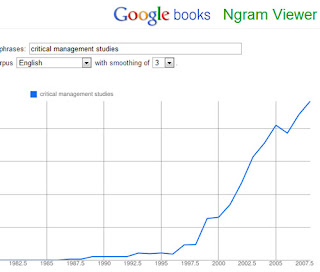
Without a doubt CMS has done well for academic publishing. Here is a graph based on Google Books.

The original conferences were about ten years ago. I am still interested in learning organisations, especially connected to ideas about quality. But the first conference was very influenced by critique and a lot of practitioner concerns got lost, in my opinion.
Without a doubt CMS has done well for academic publishing. Here is a graph based on Google Books.

The growth starts befor the time of the conferences and has continued strongly.
But a search of Google Trends in general shows no significant result.

This suggests that CMS has been an academic project that has no connection with a public. This might explain why conferences that ionvolve both academics and practitioners are rare. And rarer now than a while ago.
The mtw3 blog has some more stats on learning organisations and dynamic capabilities.
Tuesday, November 22, 2011
There is the start of an update for Management Theory at Work, two conferences from around ten years ago.
A blog has started and there is a LinkedIn group #mtw3
As memory serves the closing session for first one did not really consider the opening keynote from John Burgoyne which was partly about how technology might assist the learning organisation. As technology changes this is a good time to have another look.
By the way, there has been a gap in posts to this blog as I now mostly post to will789gb on Posterous, an effort to integrate various flows.
http://will789gb.posterous.com/
A blog has started and there is a LinkedIn group #mtw3
As memory serves the closing session for first one did not really consider the opening keynote from John Burgoyne which was partly about how technology might assist the learning organisation. As technology changes this is a good time to have another look.
By the way, there has been a gap in posts to this blog as I now mostly post to will789gb on Posterous, an effort to integrate various flows.
http://will789gb.posterous.com/
Monday, January 17, 2011


Wednesday, June 02, 2010
Thinking about the Experimentality event, I will start with the Dark Side of Mode II Knowledge. This is where many people are at and by clarifying this it could be possible to move on to whether quality ideas can help with anything at all, like dissemination. A collection of papers in book form could be one product. From IPEX I am aware that short run books are possible. The binding kit is under rapid development. Not sure where it is in production, but this could be a case study. Social media etc also relevant. The official blog has some links but more could be happening.
Tuesday, June 01, 2010
Thinking about the Experimentality conference and what to put in my paper, I think I will go back to issues around e-learning, quality and learning organisations. I got a bit lost here around the time of the emphasis on leadership and/or critique. not sure about this but it may be possible now to get closer to something I can understand.
There is video from the recent Networked Learning conference that covers the opening session. After a couple of views it is getting easier to follow. However I am still confused about the manifesto, or the reasons to drop the manifesto, or what is proposed otherwise. There is a summary page with links to four papers and an intro but I am still working through this. I think the idea of a manifesto has been dropped. Possibly the relation to technology has been dropped. Criteria for network learning do not depend on a digital context. But I am not sure what the policy suggestion is or how it is to be disseminated.
(Not too far off topic for the Experimentality event. If there is a "Lancaster Declaration" from social activists
then there are questions about how easy it will be to understand and how widely it will be published)
I am starting with "Learning, Teaching and Assessment in Networked Learning" by Vivien Hodgson and Michael Reynolds. It starts off as if there is a connection with quality that I could follow-
Ferreday, D., Hodgson, V.E. and Jones, C. (2006), Dialogue, language and identity: critical issues for networked management learning, Studies in Continuing Education Vol. 28 (3) 223 – 239.
Ferreday, D., Hodgson V. and Jones, C. (2006b ) Developing the Theory and Practice of Networked Management Learning, CEL working paper.
The Centre for Excellence in Leadership is now merged into the Learning and Skills Improvement Service but there are some publications still online. This may link but I cannot find ones on e-learning. There was a conference on Re-Thinking Leadership that again I found quite hard to follow. With BECTA closing it is not obvious where the energy will be for technology innovation in education. Any clues on which set of initials might do what would be welcome.
Previously some ideas about Learning Organisations were presented in ways that managers could understand. It would be interesting to revisit this and network learning. Technology and social practice make possible forms of activity that were not available ten years ago. I would like to look at the Experimentality website as an example. Links to other sites could improve the blog. So far there is not much conversation around it.
Meanwhile, it is possible there will be more about the Manifesto on the Networked Learning website. I would welcome some intro in a few thousand words.
There is video from the recent Networked Learning conference that covers the opening session. After a couple of views it is getting easier to follow. However I am still confused about the manifesto, or the reasons to drop the manifesto, or what is proposed otherwise. There is a summary page with links to four papers and an intro but I am still working through this. I think the idea of a manifesto has been dropped. Possibly the relation to technology has been dropped. Criteria for network learning do not depend on a digital context. But I am not sure what the policy suggestion is or how it is to be disseminated.
(Not too far off topic for the Experimentality event. If there is a "Lancaster Declaration" from social activists
then there are questions about how easy it will be to understand and how widely it will be published)
I am starting with "Learning, Teaching and Assessment in Networked Learning" by Vivien Hodgson and Michael Reynolds. It starts off as if there is a connection with quality that I could follow-
Educational values which contribute to quality in learning and teaching environments are those that seek to encourage dialogue, exchange of ideas, intrinsic approaches to study and engagement. It is this that we need to support through networked e-learning.So quality is in there somehow, but it is unclear to me what form of practice would meet the aims
In summary then we are suggesting that networked learning can be seen to be aspiring to provide a space and a place for dialogue and interaction that not only supports the co-construction of knowledge, identity and learning but also where this co-construction is exposed to critical analysis and reflection.There is reference to previous publications
Ferreday, D., Hodgson, V.E. and Jones, C. (2006), Dialogue, language and identity: critical issues for networked management learning, Studies in Continuing Education Vol. 28 (3) 223 – 239.
Ferreday, D., Hodgson V. and Jones, C. (2006b ) Developing the Theory and Practice of Networked Management Learning, CEL working paper.
The Centre for Excellence in Leadership is now merged into the Learning and Skills Improvement Service but there are some publications still online. This may link but I cannot find ones on e-learning. There was a conference on Re-Thinking Leadership that again I found quite hard to follow. With BECTA closing it is not obvious where the energy will be for technology innovation in education. Any clues on which set of initials might do what would be welcome.
Previously some ideas about Learning Organisations were presented in ways that managers could understand. It would be interesting to revisit this and network learning. Technology and social practice make possible forms of activity that were not available ten years ago. I would like to look at the Experimentality website as an example. Links to other sites could improve the blog. So far there is not much conversation around it.
Meanwhile, it is possible there will be more about the Manifesto on the Networked Learning website. I would welcome some intro in a few thousand words.
Wednesday, May 12, 2010
The Experimentality project now have a poster (warning large PDF file) for the conference with an edited text that gives an idea of what the project is about.
So economy is in there, and also education.
What I found previously is that quality is not often considered along with learning. Perhaps quality assurance is part of modernity and education values something medieval. Not sure if that is the right word, but there must be something before modernity that was better. I will look at e-learning for examples of where quality ideas could be relevant and useful. From Cloudworks I have followed the recent Networked Learning Conference. There will be more online about the Networked Learning Manifesto. This may not be a manifesto in a future manifestation but it will outline concerns about how technology relates to education. Another Cloud links to a Review of Open Educational Practices (OPAL Project deliverable D3.1 ) which covers both strategy and quality assurance. I think the link could be stronger between the two. So far my impression is that quality assurance is seen as a control, with limited input into system review or policy.
But there may be other views at the conference.
The idea of experimentation was always at the heart of modernity’s promise of human freedom and self-determination. But, after the experience of the twentieth century, is the experiment now too complicit with power to act as a carrier of hope? Or can its progressive potential be restored through an inquiry into the different forms that it takes in science, technology, the arts and wider culture? To close the year-long Experimentality programme, participants at this international conference will debate different visions of an experimental society in which the emancipatory potential of the experiment could be renewed.So my paper on Plan-Do-Check / Study - Act is still more or less on topic but there is not much in this text about business and organisation, There is another text with sort of tags -
science / politics / economy / publics / religion / music / art
education / design / media / advertising / technology
laboratory / simulating / making / performing / testing / trial
democracy / reflexivity / creativity / event / revolution
So economy is in there, and also education.
What I found previously is that quality is not often considered along with learning. Perhaps quality assurance is part of modernity and education values something medieval. Not sure if that is the right word, but there must be something before modernity that was better. I will look at e-learning for examples of where quality ideas could be relevant and useful. From Cloudworks I have followed the recent Networked Learning Conference. There will be more online about the Networked Learning Manifesto. This may not be a manifesto in a future manifestation but it will outline concerns about how technology relates to education. Another Cloud links to a Review of Open Educational Practices (OPAL Project deliverable D3.1 ) which covers both strategy and quality assurance. I think the link could be stronger between the two. So far my impression is that quality assurance is seen as a control, with limited input into system review or policy.
But there may be other views at the conference.
Wednesday, May 05, 2010
The Networked Learning Conference seems to have worked out really well. I have followed it mostly through Cloudworks and Twitter (#nlc2010). A lot of content shows up on Slideshare so I have an idea of what is going on. The actual papers will turn up as PDF later. I got the impression that there is a lot of involvement in actual projects. Over the last ten years or so there have been some doubts about where the technology was taking education. There is still a critique but the technology is being used. There was mention of social media but the term "Networked Learning" continues. This may not be about technology though. More on this later. So far I have not found much for the session on a possible Manifesto update. This was launched as part of the e-quality project so may have had a link to quality. I never understood what this was though.
Previously I saw an Adobe Connect webinar about Social Inclusion, Web2 and Language Teaching. Also links through Cloudworks. This was definitely about social media. By the way, so far I have not come across "Technology Enhanced Learning" at either event. Maybe a mention but not as a constant or description of what the event is about. There is a lot of buzz about social media and I take these two events to show that there is now an academic frame of reference.
Previously I saw an Adobe Connect webinar about Social Inclusion, Web2 and Language Teaching. Also links through Cloudworks. This was definitely about social media. By the way, so far I have not come across "Technology Enhanced Learning" at either event. Maybe a mention but not as a constant or description of what the event is about. There is a lot of buzz about social media and I take these two events to show that there is now an academic frame of reference.
Tuesday, April 27, 2010
Draft paper for Experimentality conference takes social media as an example of applied quality theory. Could be a loop. Continues online till July. Then could be an actual walk but more likely slides.
Plan, Do, Check _ Study, Act
Plan, Do, Check _ Study, Act
I am thinking about the Experimentality conference and my paper on PDSA. It is turning more into social media / journalism. Links to bits and pieces. Not sure that is a bad thing. there could be a paper version later. The conference is not till July. Meanwhile the next month is around IPEX. I am going to concentrate on this as I think the print industry is changing quite rapidly as part of communication. It has to relate to social media.
The "Tales of Things" site is still a puzzle. Not quite sure what to do with it. I have found a Banksy example, a barcode on a Camden wall that links to Youtube of how it was before Camden Council removed it. So these "things" can be from previously. they just have to have a tale linked in and a photo to base it on. I will try to formulate a better guide to how sites could link together as a script. It turns out the agenda is crowded already so a walk may need to be just a guide, not expected in real time.
The "Tales of Things" site is still a puzzle. Not quite sure what to do with it. I have found a Banksy example, a barcode on a Camden wall that links to Youtube of how it was before Camden Council removed it. So these "things" can be from previously. they just have to have a tale linked in and a photo to base it on. I will try to formulate a better guide to how sites could link together as a script. It turns out the agenda is crowded already so a walk may need to be just a guide, not expected in real time.
Sunday, April 25, 2010
I am not sure I am using Tales of Things as intended. Certainly I got it wrong the first time when I got confused about a RFID number. I now realise this is optional, the unique ID turns up later as a 2D barcode. My friend Gary sent me a PDf of his fridge lighting so then i realised it was possible and persevered. Also one of the first things loaded was BBC Broadcasting House. Or really that is to say a photograph of Broadcasting House taken some time ago, as is the case with all still photographs. So I loaded several photos of places in Lancaster following a trip there a couple of weeks ago.
I had intended to set up some meetings based on Gowalla, a location site for social media. In Exeter the tweets from the City Centre Manager since #likeminds have alerted me to how Gowalla could work even though my phone is too out of date to register geo positioning. On the Lancaster campus I found three Gowalla locations, MJR Web in the Info21 building, the Management School and Pizzetta Republic. The sort of script I have in mind for a workshop starts with some technology vision, considers critique from academics, and connects with a wider public space. So these three sites could work as a set. However as it turned out MJR Web were busy though there could be a meeting through email another time. And one of the meetings happened in the middle of Lancaster the city.
So what I have done is to add photos of locations on campus and in the city. Search talesofthings.com on "Lancaster". Not much there as on April 25th so mine can be found.

So the set of photos make up a sort of map or could be arranged as such. There is some confusion as a university campus is no longer close to the city. Art galleries can take on the role of critique. Associated views include a reluctance to accept mass production. The website prints an A4 sheet with a 2D barcode for each object, in this case a photo of a place.
I will be interested in how this might work. I am thinking about other localities such as Earl's Court. The London Book Fair filled the whole ground floor except the part of EC2 where Total Print Expo happened a couple of years ago. I speculate about Total Print alongside the Book Fair, near the Digital zone with the sony Reader etc. The idea of places as remembered barcodes helps to mix up times. One realirty is that the 2009 Total Print Expo was cancelled and that IPEX is not till May. However, the ePUB, XML, cloud publishing etc. from the Digital Zone represents a challenge the print industry could respond to. Imagining a Total Print in April 2010 has some sort of point. Also if it happened as part of the Book Fair there would be access to the Cromwell Room. The worst thing about the London College of Communication Futures Conference was walking round to the front of the Earls Court 1 just to get a lift and then walk most of the way back again.
Next week there is Internet World and also InfoSecurity. I wonder if it will be possible to move between them? Earls Court is such a confusing place that a set of barcodes to shuffle may be easier to handle. Two interesting ones will be the stand for Brand Republic and the keynote the Keynote Theatre where Meg Pickard will explain how the Guardian is making media social. through Printweek I usually get the view that Haymarket still has a focus on hard copy. The print journalists in the Guardian sometimes raise issues about bloggers. But Earls Court seems to be a place to assess the timescale if anything changes.
I had intended to set up some meetings based on Gowalla, a location site for social media. In Exeter the tweets from the City Centre Manager since #likeminds have alerted me to how Gowalla could work even though my phone is too out of date to register geo positioning. On the Lancaster campus I found three Gowalla locations, MJR Web in the Info21 building, the Management School and Pizzetta Republic. The sort of script I have in mind for a workshop starts with some technology vision, considers critique from academics, and connects with a wider public space. So these three sites could work as a set. However as it turned out MJR Web were busy though there could be a meeting through email another time. And one of the meetings happened in the middle of Lancaster the city.
So what I have done is to add photos of locations on campus and in the city. Search talesofthings.com on "Lancaster". Not much there as on April 25th so mine can be found.

So the set of photos make up a sort of map or could be arranged as such. There is some confusion as a university campus is no longer close to the city. Art galleries can take on the role of critique. Associated views include a reluctance to accept mass production. The website prints an A4 sheet with a 2D barcode for each object, in this case a photo of a place.
I will be interested in how this might work. I am thinking about other localities such as Earl's Court. The London Book Fair filled the whole ground floor except the part of EC2 where Total Print Expo happened a couple of years ago. I speculate about Total Print alongside the Book Fair, near the Digital zone with the sony Reader etc. The idea of places as remembered barcodes helps to mix up times. One realirty is that the 2009 Total Print Expo was cancelled and that IPEX is not till May. However, the ePUB, XML, cloud publishing etc. from the Digital Zone represents a challenge the print industry could respond to. Imagining a Total Print in April 2010 has some sort of point. Also if it happened as part of the Book Fair there would be access to the Cromwell Room. The worst thing about the London College of Communication Futures Conference was walking round to the front of the Earls Court 1 just to get a lift and then walk most of the way back again.
Next week there is Internet World and also InfoSecurity. I wonder if it will be possible to move between them? Earls Court is such a confusing place that a set of barcodes to shuffle may be easier to handle. Two interesting ones will be the stand for Brand Republic and the keynote the Keynote Theatre where Meg Pickard will explain how the Guardian is making media social. through Printweek I usually get the view that Haymarket still has a focus on hard copy. The print journalists in the Guardian sometimes raise issues about bloggers. But Earls Court seems to be a place to assess the timescale if anything changes.
Saturday, April 17, 2010
Tales of Things is a new site that links online with the real world. So far it seems that a photo and a place are much the same. They offer a 2D barcode for any site or object, then link in stories as other media.
so i have started with a few places in Lancaster - both campus and city centre. The "Star of CCTV" badge is an extra.
will789gb (1)
so i have started with a few places in Lancaster - both campus and city centre. The "Star of CCTV" badge is an extra.
will789gb (1)
Tuesday, March 30, 2010
Thinking about #likeminds in Exeter. The circus has left town. Not sure where it is. Easter in Lancaster so I plan to stay for a while and check out the campus. I have looked at location services and cannot make much sense of them. It could work better if each location had some significance. Previously i thought about a walk towards the Learning Zone but so far on Gowalla I can only find a web company in the InfoLab, the Management School and Pizza Republic. These are each at one end so could do as a start. Assume MJR Web is more or less the cafe. Broadly positive about social media with some sort of quality idea as well. Moving to the Management School cafe for critique. Ending up in Pizza Republic for reflection and connection with civic society. (This may get more complicated by the time of the Experimentality conference with more locations)
I will bring a video camera but batteries are always low so mains electricity is a factor. Chat show mode assumed for the moment.

I will bring a video camera but batteries are always low so mains electricity is a factor. Chat show mode assumed for the moment.

Sunday, March 28, 2010
Still thinking about the Experimentality paper about Check / Study. I would like to concentrate on why both words are used and what they mean in Japan and USA. But I am not sure about the context. So far there is not much around management turning up on the Experimentality stream. Also my blog / citizen journalism / web video approach is going in another direction to the structured paper. So I think I will go more into blog mode and come back to a paper nearer the time.
There are three groups of words, three sections, each could have a #tag. #dsm2 for dark side of mode 2. In other words why don't academics have much concern for quality theory? Clearly this is a generalisation. Cloudworks from the OU has quality in the scope and is engaged in practice. But my guess at the moment is that this is rare in the UK.
#checkstudy could work PDCA or PDSA. Try it anyway. My claim is to be mostly on topic. There is something about experimentality at the core of ISO management standards.
Social media or social communication are still on track to remain topical through 2010. Various # apply. Online Information Looking at relation to quality theory offers some interesting case studies. Document control?
Which bit to start with for a paper depends on the rest of the conference but meanwhile online, any connections can be explored.
Over the next few months I intend to do several stories about print around IPEX and the London Book Fair. I need to speculate about Online Information in December to make sense of this. So a similar approach to Experimentality could take in other events that have not yet happened. Then revise it during the rest of the year. There is a new network called Stringbag that appears to continue research on learning organisations. I got lost on how this discussion related to network learning. It seemed to be a bit disjointed from practice. So the Network Learning conference will be interesting and more will emerge from Stringbag over time. It starts in April with a real space conference for subscribers, the freebie online version follows later.
Web Science may be a new subject but not well known yet. I think it includes emerging properties or unintended consequences. So although the web seems to be doing ok anyway, further study may result in better understanding. There is a conference in April but I will probably better understand the version at Olympia in December. Maybe David Weinberger again as a speaker would clarify the science.
Usually I find that Online Information clashed with the Deming SIG of theCQI. Maybe this year it won't matter. Perhaps the e-book and social media will have moved up the agenda to Tuesday or Wednesday. Or there could be a half day meeting followed by a 9 or 10 bus.
Trying out new Amazon widget
There are three groups of words, three sections, each could have a #tag. #dsm2 for dark side of mode 2. In other words why don't academics have much concern for quality theory? Clearly this is a generalisation. Cloudworks from the OU has quality in the scope and is engaged in practice. But my guess at the moment is that this is rare in the UK.
#checkstudy could work PDCA or PDSA. Try it anyway. My claim is to be mostly on topic. There is something about experimentality at the core of ISO management standards.
Social media or social communication are still on track to remain topical through 2010. Various # apply. Online Information Looking at relation to quality theory offers some interesting case studies. Document control?
Which bit to start with for a paper depends on the rest of the conference but meanwhile online, any connections can be explored.
Over the next few months I intend to do several stories about print around IPEX and the London Book Fair. I need to speculate about Online Information in December to make sense of this. So a similar approach to Experimentality could take in other events that have not yet happened. Then revise it during the rest of the year. There is a new network called Stringbag that appears to continue research on learning organisations. I got lost on how this discussion related to network learning. It seemed to be a bit disjointed from practice. So the Network Learning conference will be interesting and more will emerge from Stringbag over time. It starts in April with a real space conference for subscribers, the freebie online version follows later.
Web Science may be a new subject but not well known yet. I think it includes emerging properties or unintended consequences. So although the web seems to be doing ok anyway, further study may result in better understanding. There is a conference in April but I will probably better understand the version at Olympia in December. Maybe David Weinberger again as a speaker would clarify the science.
Usually I find that Online Information clashed with the Deming SIG of theCQI. Maybe this year it won't matter. Perhaps the e-book and social media will have moved up the agenda to Tuesday or Wednesday. Or there could be a half day meeting followed by a 9 or 10 bus.
Trying out new Amazon widget
Subscribe to:
Posts (Atom)