Trying out how to embed video. The link works ok in the previous post but I am inspired by an example on Buzzmachine from Jeff Jarvis.
So here is a copy of some YouTube code-
Wednesday, October 11, 2006
Email may not be junk. I recently got a newsletter from Epic that makes more sense than most of what I come across about e-learning. Steve Barden's article is headed "Latest Leadership Thinking – Let 'Me' Be Your Leader". It looks at how informal learning is taking advantage of technology.
"To a great extent I think the learning culture in many organisations has moved faster than the culture of training. Learners have taken to doing it for themselves through Google and a whole range of new online collaborative resources and tools. Informal learning has eaten into training territory on the back of this online expansion and significantly affected the learning culture."
It seems to me that YouTube could be included here. There is some mindbending rubbish but also some detailed instruction. Until recently, searching on "Bert Jansch" found almost nothing by Bert Jansch but several home videos of private performances. There is an extensive discussion including requests for detailed views of how a tune is played. See for example . The comments include some criticism that is then accepted, so don't take this as the best example for the little finger.
The discussion also covers the correct spelling of "Anji" or "Angie" quoting use over fourty years of history. "Angie" may be a different tune, only based on work by
Davey Graham. Since October 5th there has also been an extract from a BBC4 tv session. This may reflect the new acceptance of YouTube or it may not last very long. Suggest Bert Jansch fans check it soon.
If this is the "new thinking on leadership", we seem to be going back to some of the ideas around the "learning organisation". Energy from people directly involved in the process, that sort of thing. Maybe the Epic thinking is for practitioners and academics are finding "leadership" more interesting as a focus. YouTube could offer some stories for more than one approach.
"To a great extent I think the learning culture in many organisations has moved faster than the culture of training. Learners have taken to doing it for themselves through Google and a whole range of new online collaborative resources and tools. Informal learning has eaten into training territory on the back of this online expansion and significantly affected the learning culture."
It seems to me that YouTube could be included here. There is some mindbending rubbish but also some detailed instruction. Until recently, searching on "Bert Jansch" found almost nothing by Bert Jansch but several home videos of private performances. There is an extensive discussion including requests for detailed views of how a tune is played. See for example . The comments include some criticism that is then accepted, so don't take this as the best example for the little finger.
The discussion also covers the correct spelling of "Anji" or "Angie" quoting use over fourty years of history. "Angie" may be a different tune, only based on work by
Davey Graham. Since October 5th there has also been an extract from a BBC4 tv session. This may reflect the new acceptance of YouTube or it may not last very long. Suggest Bert Jansch fans check it soon.
If this is the "new thinking on leadership", we seem to be going back to some of the ideas around the "learning organisation". Energy from people directly involved in the process, that sort of thing. Maybe the Epic thinking is for practitioners and academics are finding "leadership" more interesting as a focus. YouTube could offer some stories for more than one approach.
Tuesday, October 10, 2006
I have added a poll at the Squidoo lens on W.E. Deming.
It asks if the Deming approach ever been tried in the USA?
It is known that Deming was listened to in Japan in the 1950s. Apparently he was listened to by Ford and others in the USA in the 1980s. Did they actually understand what he was saying?
Keep scrolling down, the poll is at the bottom of the page.
It asks if the Deming approach ever been tried in the USA?
It is known that Deming was listened to in Japan in the 1950s. Apparently he was listened to by Ford and others in the USA in the 1980s. Did they actually understand what he was saying?
Keep scrolling down, the poll is at the bottom of the page.
I am beginning to get stats on my Adwords program. Five actualk clickthoughs so far but lots of info on words that are used.
"search constructed knowledge" has had no interest at all so I have taken it out of the copy. Replaced by "learning with search". "Learning" has a following so this may work better.
"search constructed knowledge" has had no interest at all so I have taken it out of the copy. Replaced by "learning with search". "Learning" has a following so this may work better.
Monday, October 02, 2006
Following Google University I have been thinking more about words and numbers and how to link in to advertising. Looking again at Eurekster it turns out they have started to include advertising so I have added this to each Swicki. I am about to get some actual stats on a global basis, well not global exactly but from the web as a whole. Previously trying to reach a UK audience has been confusing, all the stats show a 15% UK audience or close to this.
Information World Review is now covering 'Office 2.0' as well as 'Enterprise 2.0'. As the Wikipedia prefers 'enterprise social software' I have decided to add all the options to the learn9 wordcloud. They are each very small at the moment. For 'enterprise 2.0' there were 130,962 sites earlier today. The 'Enterprise Social Software' in Wikipedia showed up ahead of the ZD Net blog. 'Office 2.0' finds 215,755 but I think some are just about Office in general. 'Enterprise Social Software' finds only 45,012 but they ae mostly interesting, extended blog writing for example. 'Information 2.0' finds 461,301 but I can't see any pattern in this. It is a term for the Online Information show. i may add it if something else happens. I may take them off again, but it seems a good way to track some of the discussion through the conference phase.
Information World Review is now covering 'Office 2.0' as well as 'Enterprise 2.0'. As the Wikipedia prefers 'enterprise social software' I have decided to add all the options to the learn9 wordcloud. They are each very small at the moment. For 'enterprise 2.0' there were 130,962 sites earlier today. The 'Enterprise Social Software' in Wikipedia showed up ahead of the ZD Net blog. 'Office 2.0' finds 215,755 but I think some are just about Office in general. 'Enterprise Social Software' finds only 45,012 but they ae mostly interesting, extended blog writing for example. 'Information 2.0' finds 461,301 but I can't see any pattern in this. It is a term for the Online Information show. i may add it if something else happens. I may take them off again, but it seems a good way to track some of the discussion through the conference phase.
Saturday, September 30, 2006

This photo from Google University at AdTech. I plan to compare this with the Online Information event later this year. In the UK normally you need the Privy Council to agree to the use of the name "University". Somehow the US approach is gaining strength that companies can set up a university as well.
More on the content later. A lot of it was round the idea of a 'quality score', mostly based on how relevant your advert would be to a particular search query. I am thinking about how this fits with other quality theory.
Meanwhile Google Video seems to have given up the struggle with YouTube and opted for the high ground and more academic content. UC Berkeley have deposited a mass of course records. I liked one about search quality but it took them a while to get the slides working. The video just rolls on, this approach is not very mysterious.
The Online Information event is around the theme of "Information 2.0". Not sure what this implies but I am trying to mix it around "Web 2.0" just to check out what the official information scene has to offer. Open Access Journals for example do not yet carry the same weight as the expensive ones but some form of knowledge exists just through search and the web in general.
I have put a comment on the official blog, following on from David Weinberger last year. The IWR blog seems to be questioning the "Web 2.0" term as suffering a loss of meaning over time. The conference in San Francisco will surely come up with something though.
Wednesday, September 27, 2006
Off to Adtech tomorrow, including the Google University. Almost entirely about advertising and stats analysis, I think. The use of 'university' as a word is a US approach, when applied to companies. Personally I think a Google University should exist all year round not just on special occasions. There is an online version so this is a case of 'blended learning'.
Meanwhile Cambridge University has come up with a new approach to A Levels. See 'Fast Forward to the Past' in the Guardian. There is a very short list of suitable subjects for a new 'pre-U' qualification for the really bright people for the top unis. 'Media Studies' is not on the list, or design technology or IT. Economics ok but not sociology. Too close to media studies probably.
Meanwhile Cambridge University has come up with a new approach to A Levels. See 'Fast Forward to the Past' in the Guardian. There is a very short list of suitable subjects for a new 'pre-U' qualification for the really bright people for the top unis. 'Media Studies' is not on the list, or design technology or IT. Economics ok but not sociology. Too close to media studies probably.
Tuesday, September 12, 2006
Back in Exeter. seem to have been in Lancaster a while.
Written for OhmyNews about buildings and open space in Morecambe.
I didn't mention the buildings on the campus as they were not part of the schedule. 76 Church Street is currently in use for a mobile computer operation. Lots of personal computers on a network. Seems to work ok even in a Jacobean / Georgian context. So why is trhe university showing off InfoLab? For 40 years or so most of the buildings were hidden from the motorway. In the discussion on the KBE there was not much discussion on technology as such. What sort of equipment is inside the building? an IBM mainframe? Some sort of cooling device for a hot chip? Maybe they could have used an old building instead. Is the shape just rhetoric in another form?
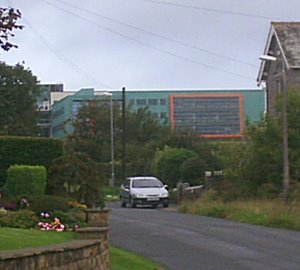
viewed from Galgate

official photo
Written for OhmyNews about buildings and open space in Morecambe.
I didn't mention the buildings on the campus as they were not part of the schedule. 76 Church Street is currently in use for a mobile computer operation. Lots of personal computers on a network. Seems to work ok even in a Jacobean / Georgian context. So why is trhe university showing off InfoLab? For 40 years or so most of the buildings were hidden from the motorway. In the discussion on the KBE there was not much discussion on technology as such. What sort of equipment is inside the building? an IBM mainframe? Some sort of cooling device for a hot chip? Maybe they could have used an old building instead. Is the shape just rhetoric in another form?
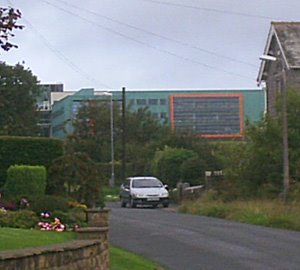
viewed from Galgate

official photo
Friday, September 01, 2006
Thursday, August 31, 2006
Day one of the Knowledge Based Economy conference. I am in the library where the web works ok but there is no coffee. Otherwise fine.
Conference has started well. the idea of knowledge is not limited to academic sources. Michael Hulme emphasised personal knowledge and collaborative knowledge creation through blogs and wikis. "The onus of critical judgement is thrown back to the individual."
John Urry commented that the role of the individual is balanced by a dependence on computers and electronic systems with 'a dark and dystopic side of systemic dependencies' liable to catastrophic failure. Not sure if systems will be seen with any encouraging potential but this is only day one.
Some discussion on whether the KBE is centred on London and the south east in the UK. One thing I notice is that the people attending are not from Oxford, Cambridge or London academic sites other than DEMOS. Not sure why this may be.
From the first workshop I discover that 'excellence' and quality are among the top issues in editorial coverage of higher education in the USA. Based on looking at 252 articles in the New York Times, LA Times and Washington Post. So quality could be a topic of interest for academics. The discussion suggested that most of the articles responding to journalists came from individual academics rather than any organised presentation by universities as a group.
Conference has started well. the idea of knowledge is not limited to academic sources. Michael Hulme emphasised personal knowledge and collaborative knowledge creation through blogs and wikis. "The onus of critical judgement is thrown back to the individual."
John Urry commented that the role of the individual is balanced by a dependence on computers and electronic systems with 'a dark and dystopic side of systemic dependencies' liable to catastrophic failure. Not sure if systems will be seen with any encouraging potential but this is only day one.
Some discussion on whether the KBE is centred on London and the south east in the UK. One thing I notice is that the people attending are not from Oxford, Cambridge or London academic sites other than DEMOS. Not sure why this may be.
From the first workshop I discover that 'excellence' and quality are among the top issues in editorial coverage of higher education in the USA. Based on looking at 252 articles in the New York Times, LA Times and Washington Post. So quality could be a topic of interest for academics. The discussion suggested that most of the articles responding to journalists came from individual academics rather than any organised presentation by universities as a group.
Tuesday, August 29, 2006
I have started a topic on the Prolearn discussion space
http://www.prolearn-online.com
forums and polls , then "Engaging SMEs in e-learning"
My paper is a bit off topic for e-learning but a lot could follow. I have put some questions about 'network management learning' at the end. I still don't understand most of what is written but it could be worked through later.
http://www.prolearn-online.com
forums and polls , then "Engaging SMEs in e-learning"
My paper is a bit off topic for e-learning but a lot could follow. I have put some questions about 'network management learning' at the end. I still don't understand most of what is written but it could be worked through later.
Monday, August 28, 2006
I have printed out copies of the paper for the IAS conference on the Knowledge Based Economy, so that is the final version this week.
PDF version now on the Learn9 site.
Also an open document. Open Office required but I am gradually getting used to it and I think most people should have access to a copy.
The slides PDF just as previously. About 2 meg.
Meanwhile I am trying to update an article on quality for OhmyNews. Previously i did one based on Quality Circles and mentioning ISO 9000 towards the end. I am trying to do another one leading on the latest ISO survey. This continues to show growth in China and slight decline in the UK. It has been suggested I should explain more about the background so this needs working on. Maybe I will get some ideas during the conference.
One problem I can't avoid is that I do not know anything about how ISO 9000 is used in China or an Asian take on quality. The journalism takes the form of asking a question. Maybe later others will send in reports to OhmyNews and the editors will shape something together.
Current version-
Continued growth in China use of ISO 9000
Mixed sector pattern in USA and UK
The ISO survey for 2005 shows continued growth in the use of ISO 9000, a standard for quality assurance and in the environmental standard ISO 14000. The two standards are connected by a common approach to auditing, systems thinking and learning through corrective action and system review. Growth continues strongly in China, where there is now the largest number of ISO 9000 certificates. Growth in the UK has stopped but there is interest in the specialised standard for medical equipment.
China now has 143,823 certificates, up by 10,000 from 2004. The ISO comments that "the strong performance of China, which is again in the top 10 countries for growth in both ISO 9001:2000 and ISO 14001 certification, and of India, which is again in the top 10 for ISO 9001:2000 growth and enters the top 10 for ISO 14001 growth, is no doubt partly linked to their increasing participation in global supply chains, in export trade and in business process outsourcing."
The standard may be seen as essential for getting onto the list of suppliers for companies that also use ISO 9000. There has not been much research on how the standards are used but given the current scale there are probably sites where the standard is being used creatively.
In the UK the number of certificates is now below 50,000 rather than above as in 2004. There had been a previous dip while companies adjusted to the revised version of the standard in 2000. The standard originally started as a UK standard (BS 5750) so some observers have suggested that the UK decline in use shows there are problems in maintaining the paperwork and that long term benefits may not occur. The 2000 revision calls for involvement by senior management in system review. It is possible that there has been some reluctance around this.
The ISO comments on the rising importance of services in the global economy. "nearly 33 % of ISO 9001:2000 certificates and 31 % of ISO 14001 certificates in 2005 went to organizations in the service sectors. The latter statistic also illustrates that good environmental management is not just for smoke stack industry and that service providers are accepting their social responsibilities in this area."
Japan is way ahead of China on the environmental standard - 23,466 compared to 12,683. The USA has just over 5,000. Japan has other approaches to quality but the support for ISO 14000 suggests that it is possible to use the methods as part of a management approach.
Figures are also published for two specialised standards based on ISO 9000. ISO 16949 covers automative products in the car industry. This replaces previous industry and company standards. In this sector the USA leads with 3,693 compared to 2,151 for China and 2,115 for Germany. The USA also leads on ISO 13485 for medical equipment with 1310 certificates, followed by the UK with 973 and Germany with 824. There has been a view that the USA has had no need to adopt ISO 9000 as quality policies already exist. This may change with the example of automative and medical. At least there will be some sectors with relevant experience.
I am unable to explain the mixed pattern across countries and sectors. There is very little information available on how the standards are used. Other reports for OhmyNews might help to give some background on particular countries or regions. The recent conference on citizen journalism considered 'best practices' so some quality theory could be relevant without getting too lost in ISO language.
There is some evidence on the web that ISO 9000 systems can work alongside quality circles and moves for improvement. Joseph Nebus has reported on a trip to Thailand where he had his first trip in an ISO 9000 certified taxi. He found much publicity for ISO 9000 also in Singapore as well as support for quality circles with 12% of the workforce participating.
By contrast, quality circles have almost disappeared in the UK. David Hutchins recently updated an article on his website originally from 1982, with this explanation-
"In the year 1998 there were reported to be more than 20 million Circles in China and in every country in the Far East. Both Toyota and Honda announced in 2004 that they are going for 100% involvement in Quality Circles in all of their plants worldwide.
Toyota and Honda are both making huge profits in their manufacturing plants in the USA, China is about to enter that market. At the same time, General Motors are reported to have lost $1.5Bn in the first six months of 2004, MG Rover was liquidated and the plant is now owned by the Chinese.
Ford also lost money and Chrysler are currently in deep trouble. Of course it is not all down to Quality Circles, it would be stupid to suggest that it was but they are part of the reason and that is good enough! Why do Toyota and Honda clearly regard the concept to be so important whilst the West completely ignores it? Who is right? ."
My previous report "Quality Control Goes Round in Circles" covered some background to this. One possibility is that the approach to quality circles has a consequence for the suitability of ISO 9000.
PDF version now on the Learn9 site.
Also an open document. Open Office required but I am gradually getting used to it and I think most people should have access to a copy.
The slides PDF just as previously. About 2 meg.
Meanwhile I am trying to update an article on quality for OhmyNews. Previously i did one based on Quality Circles and mentioning ISO 9000 towards the end. I am trying to do another one leading on the latest ISO survey. This continues to show growth in China and slight decline in the UK. It has been suggested I should explain more about the background so this needs working on. Maybe I will get some ideas during the conference.
One problem I can't avoid is that I do not know anything about how ISO 9000 is used in China or an Asian take on quality. The journalism takes the form of asking a question. Maybe later others will send in reports to OhmyNews and the editors will shape something together.
Current version-
Continued growth in China use of ISO 9000
Mixed sector pattern in USA and UK
The ISO survey for 2005 shows continued growth in the use of ISO 9000, a standard for quality assurance and in the environmental standard ISO 14000. The two standards are connected by a common approach to auditing, systems thinking and learning through corrective action and system review. Growth continues strongly in China, where there is now the largest number of ISO 9000 certificates. Growth in the UK has stopped but there is interest in the specialised standard for medical equipment.
China now has 143,823 certificates, up by 10,000 from 2004. The ISO comments that "the strong performance of China, which is again in the top 10 countries for growth in both ISO 9001:2000 and ISO 14001 certification, and of India, which is again in the top 10 for ISO 9001:2000 growth and enters the top 10 for ISO 14001 growth, is no doubt partly linked to their increasing participation in global supply chains, in export trade and in business process outsourcing."
The standard may be seen as essential for getting onto the list of suppliers for companies that also use ISO 9000. There has not been much research on how the standards are used but given the current scale there are probably sites where the standard is being used creatively.
In the UK the number of certificates is now below 50,000 rather than above as in 2004. There had been a previous dip while companies adjusted to the revised version of the standard in 2000. The standard originally started as a UK standard (BS 5750) so some observers have suggested that the UK decline in use shows there are problems in maintaining the paperwork and that long term benefits may not occur. The 2000 revision calls for involvement by senior management in system review. It is possible that there has been some reluctance around this.
The ISO comments on the rising importance of services in the global economy. "nearly 33 % of ISO 9001:2000 certificates and 31 % of ISO 14001 certificates in 2005 went to organizations in the service sectors. The latter statistic also illustrates that good environmental management is not just for smoke stack industry and that service providers are accepting their social responsibilities in this area."
Japan is way ahead of China on the environmental standard - 23,466 compared to 12,683. The USA has just over 5,000. Japan has other approaches to quality but the support for ISO 14000 suggests that it is possible to use the methods as part of a management approach.
Figures are also published for two specialised standards based on ISO 9000. ISO 16949 covers automative products in the car industry. This replaces previous industry and company standards. In this sector the USA leads with 3,693 compared to 2,151 for China and 2,115 for Germany. The USA also leads on ISO 13485 for medical equipment with 1310 certificates, followed by the UK with 973 and Germany with 824. There has been a view that the USA has had no need to adopt ISO 9000 as quality policies already exist. This may change with the example of automative and medical. At least there will be some sectors with relevant experience.
I am unable to explain the mixed pattern across countries and sectors. There is very little information available on how the standards are used. Other reports for OhmyNews might help to give some background on particular countries or regions. The recent conference on citizen journalism considered 'best practices' so some quality theory could be relevant without getting too lost in ISO language.
There is some evidence on the web that ISO 9000 systems can work alongside quality circles and moves for improvement. Joseph Nebus has reported on a trip to Thailand where he had his first trip in an ISO 9000 certified taxi. He found much publicity for ISO 9000 also in Singapore as well as support for quality circles with 12% of the workforce participating.
By contrast, quality circles have almost disappeared in the UK. David Hutchins recently updated an article on his website originally from 1982, with this explanation-
"In the year 1998 there were reported to be more than 20 million Circles in China and in every country in the Far East. Both Toyota and Honda announced in 2004 that they are going for 100% involvement in Quality Circles in all of their plants worldwide.
Toyota and Honda are both making huge profits in their manufacturing plants in the USA, China is about to enter that market. At the same time, General Motors are reported to have lost $1.5Bn in the first six months of 2004, MG Rover was liquidated and the plant is now owned by the Chinese.
Ford also lost money and Chrysler are currently in deep trouble. Of course it is not all down to Quality Circles, it would be stupid to suggest that it was but they are part of the reason and that is good enough! Why do Toyota and Honda clearly regard the concept to be so important whilst the West completely ignores it? Who is right? ."
My previous report "Quality Control Goes Round in Circles" covered some background to this. One possibility is that the approach to quality circles has a consequence for the suitability of ISO 9000.
Saturday, August 26, 2006
I have started up a home on US Cyworld. It takes a while to get used to this. Mostly for swapping music files etc. i guess but I am also interested in how quality ideas fit in. I found out about Cyworld through OhmyNews. The US launch is a new phase. I have started a 'quality club'. Unfortunately I can't load a text or graphic. Text ok but graphic falls over and then you can't save anything. I think the launch is official, not a beta site but still an issue there I think. Maybe I should be scrolling down to some other button.
I have written for OhmyNews a report on the latest ISO survey on 9000 and 14000. The growth in Asia contrasts with UK stasis. Hard to explain and I can't claim to know what is happening. OhmyNews and Cyworld may contribute a space for a discussion. They are based in Korea but gradually involving wider communities.
I have written for OhmyNews a report on the latest ISO survey on 9000 and 14000. The growth in Asia contrasts with UK stasis. Hard to explain and I can't claim to know what is happening. OhmyNews and Cyworld may contribute a space for a discussion. They are based in Korea but gradually involving wider communities.
Friday, July 14, 2006
Meanwhile the OhmyNews Forum has been totally solid as far as I can tell. I have been back to sleep so am more or less on UK time now. The webcast worked ok for sound, then mostly stills a bit jerky. The slides were missing sometimes. Still, a lot will turn up later.
I think the move to start something in Japan will probably work ok. There may be more podcasts and video as things turn out.
The Korean base seems really strong in social terms as well as technology. My impression is they did less visits than last year to technology sites. But there was mention of wireless speeds as a government concern.
The 'knowledge-based economy' is a reality in Incheon.
I think the move to start something in Japan will probably work ok. There may be more podcasts and video as things turn out.
The Korean base seems really strong in social terms as well as technology. My impression is they did less visits than last year to technology sites. But there was mention of wireless speeds as a government concern.
The 'knowledge-based economy' is a reality in Incheon.
Next week there is a space for my paper during the workshop on organisations as part of the Lancaster IAS project on the Knowledge Based Economy. It seems awfully soon.
the paper is intended for the conference at the end od August. I have redone the website more or less as a sequence so I will work some more on that.
I get the impression there is more readiness to look at quality and organisation, even as part of a critique of some rhetoric. There will be a look at cultural industries involving the local RDA as part of the conference so there must be some reality to it.
I notice Peter Checkland has a new book coming out - Learning for Action - that seems to be an introduction to other works, including information systems. I think I will add this in. I have always thougt that SSM was about learning but somehow the Department of Management Learning has rarely made much of a connection. And contrarywise. I can't remember anyone from Management Science being at the conferences organised by Management Learning.
The Institute for Advanced Studies is not based in a particular discipline so this could be a good chance to look at this again.
the paper is intended for the conference at the end od August. I have redone the website more or less as a sequence so I will work some more on that.
I get the impression there is more readiness to look at quality and organisation, even as part of a critique of some rhetoric. There will be a look at cultural industries involving the local RDA as part of the conference so there must be some reality to it.
I notice Peter Checkland has a new book coming out - Learning for Action - that seems to be an introduction to other works, including information systems. I think I will add this in. I have always thougt that SSM was about learning but somehow the Department of Management Learning has rarely made much of a connection. And contrarywise. I can't remember anyone from Management Science being at the conferences organised by Management Learning.
The Institute for Advanced Studies is not based in a particular discipline so this could be a good chance to look at this again.
Wednesday, July 12, 2006
The OhmyNews Forum is about to start. They are eight hours ahead of UK so tomorrow is a bit sooner.
There is a story already with a welcome and comments from Oh Yeon-ho, founder and CEO of OhmyNews
------------------------
"Two of the most prominent buzzwords in recent years have been Web 2.0 and UCC (user-created content). Underlying both concepts is the belief that collective participation will lead to an optimum solution or conclusion. In other words, decisions will best be made when there is truly mass participation through the Internet.
While giant corporations rush to find a way of commercializing these concepts, citizen journalism, I believe, represents the most developed model for Web 2.0 and UCC. It depends not only on the participation of the masses but on the participation of those who think critically and creatively.
Writing a news story requires a good deal of time and consideration. It is much more difficult, for example, than leaving a comment or posting a blog entry. Though we are an open platform accessible to everyone, not everyone can write a news story. Only those citizen reporters who are passionately committed to social change and reporting make our project possible. The main reason that citizen journalism has not grown and spread more rapidly is the difficult task of finding and organizing these passionate citizen reporters in waiting."
----------------------
I think these issues are very relevant for my attempts to link ideas about quality and learning. Oh Yeon-ho speaks of the difficulties of "organizing" so there is an organisation aspect to what OhmyNews is developing. I think there is a quality aspect when he says that underlying both the concepts of Web 2.0 and User Created Content "is the belief that collective participation will lead to an optimum solution or conclusion."
To say that citizen journalism is "the most advanced model" for both Web 2.0 and UCC is a significant claim and is making sense so far.
The webcast could be about 2 or 3 pm UK time. Not sure if there is a repeat.
There is a story already with a welcome and comments from Oh Yeon-ho, founder and CEO of OhmyNews
------------------------
"Two of the most prominent buzzwords in recent years have been Web 2.0 and UCC (user-created content). Underlying both concepts is the belief that collective participation will lead to an optimum solution or conclusion. In other words, decisions will best be made when there is truly mass participation through the Internet.
While giant corporations rush to find a way of commercializing these concepts, citizen journalism, I believe, represents the most developed model for Web 2.0 and UCC. It depends not only on the participation of the masses but on the participation of those who think critically and creatively.
Writing a news story requires a good deal of time and consideration. It is much more difficult, for example, than leaving a comment or posting a blog entry. Though we are an open platform accessible to everyone, not everyone can write a news story. Only those citizen reporters who are passionately committed to social change and reporting make our project possible. The main reason that citizen journalism has not grown and spread more rapidly is the difficult task of finding and organizing these passionate citizen reporters in waiting."
----------------------
I think these issues are very relevant for my attempts to link ideas about quality and learning. Oh Yeon-ho speaks of the difficulties of "organizing" so there is an organisation aspect to what OhmyNews is developing. I think there is a quality aspect when he says that underlying both the concepts of Web 2.0 and User Created Content "is the belief that collective participation will lead to an optimum solution or conclusion."
To say that citizen journalism is "the most advanced model" for both Web 2.0 and UCC is a significant claim and is making sense so far.
The webcast could be about 2 or 3 pm UK time. Not sure if there is a repeat.
Thursday, June 29, 2006
I have added a page about stats for the paper draft. The recent Deming SIG meeting on SPC reminded me that this an aspect of websites I often forget. The problem with the UK Acrobat Services site is that most of the audience is not from the UK. Nothing seems to change this. I started the US focus site with a ".com" and the first page of the co.uk suggests people go there if they are not in the UK. Not much difference, the process is not in control.
But the Swickis seem to be working ok in terms of getting searches more or less as expected.
'soft systems' is doing well on the learn9 swicki. I may try to look at this again. There may not be enough time for this at the conference but it could come up as part of looking at Deming on systems thinking.
But the Swickis seem to be working ok in terms of getting searches more or less as expected.
'soft systems' is doing well on the learn9 swicki. I may try to look at this again. There may not be enough time for this at the conference but it could come up as part of looking at Deming on systems thinking.
I have started to look at Prolearn again. They are an EU project on professional e-learning. My impression is they have no problem in admitting 'quality' as an element in their thinking. They want to end up with methods that can be shared with people working in companies. That is not to stop them coming up with new research ideas of course. Just because they accept quality they are not restricted to a 'positive' methodology. Recent conference on social software. Links to blog. Links to blog conference. Maybe it is just another example of rhetoric to disguise a neo-liberal project. But I think there will be more to find on Prolearn that is interesting for the KBE discussion.
Later today there should be a guide to other blogs that I work on or at least a diagram as part of my learn9 website. This is about learning so one current idea is to make the blogs at least appear more coherent. I have tended to just start another one and then not continue.
Thursday, June 22, 2006
Just had another look at M@n@gement. The site design has been updated. Much better, in my opinion. More space around things. Previously it looked to me that the list of articles was the only focus. Now it is easier to navigate the site. Also there is a search option, using Google. The only problem I find is the page with a form for submitting an article. At least this has a date - autumn 2006 - when nthe form will be available. This is consistent with a corrective action procedure.
Also the description of what they will accept mentions video, sound anything that fits. So far I can't find examples where this is used.
Also the description of what they will accept mentions video, sound anything that fits. So far I can't find examples where this is used.
Subscribe to:
Posts (Atom)